

Feeding Guides
Best Foods to Increase Toddler Weight: Nutrient-Dense Options That Actually Work
Laeeka Edries·11 min read

Is your baby ready for table food? Learn the actual readiness signs beyond age six months: sitting, grasping, and hunger cues that signal safe transition.
Here’s what nobody tells you about table food readiness: six months is a suggestion, not a deadline. Some babies are lunging at your fork at five months; others aren’t ready until closer to eight. The real sign your baby is ready for table food has nothing to do with their age and everything to do with what their body can actually do.
Most pediatricians cite six months because that’s when most babies hit the physical benchmarks that matter: sitting upright with minimal support, loss of the tongue-thrust reflex, and the ability to rake food toward their mouth. But those milestones are what you should watch for — not the calendar. This guide breaks down the actual readiness signs across motor skills, hunger cues, and behavior, plus how to spot red flags before they become a feeding battle.
Every pediatrician will tell you “around six months.” And that’s a reasonable starting point. But here’s what they don’t always say out loud: six months is a ballpark, not a deadline.
Some babies hit five months and are practically lunging at your fork. Others are closer to seven or eight months before anything clicks. Both of those are normal.
What actually matters more than the date on the calendar is what your baby’s body is doing. Developmental readiness is the real signal — and it shows up in physical milestones, not months.
The reason six months gets cited so often is that most babies reach the necessary physical benchmarks around that time. Things like head and neck control, the ability to sit with minimal support, and the loss of the tongue-thrust reflex — that automatic push-out move babies do when anything solid touches their tongue.
That reflex is actually protective. It’s there to prevent choking. When it fades, that’s your baby’s body saying it’s getting closer to ready.
You can track weight and length all day — and your baby growth chart percentiles do matter for the bigger development picture — but no number on a chart tells you whether your specific baby is ready to sit up at a table and handle something thicker than milk.
Watch your baby. Not the calendar.
If you’re already thinking about the practical side of this transition, it’s also worth starting to look at seating. A stable, supportive seat makes a real difference once solids begin — our high chair buying guide breaks down exactly what to look for.
Here’s the thing nobody tells you clearly enough: readiness isn’t one sign. It’s a cluster of them — and you need most of them showing up together before table food is actually safe.
The first one is sitting. Your baby needs to sit upright with minimal support and hold that position while they’re focused on something else — like food. If they’re slumping, they’re not ready. A wobbly sitter is a choking risk, full stop.
Next is the tongue-thrust reflex. Babies are born pushing things out of their mouths — it’s a protective reflex. When it fades (usually somewhere between four and six months), food can actually move to the back of the mouth instead of straight back out. If you offer a tiny bit of soft food and it keeps getting pushed back at you, that reflex is still doing its job.
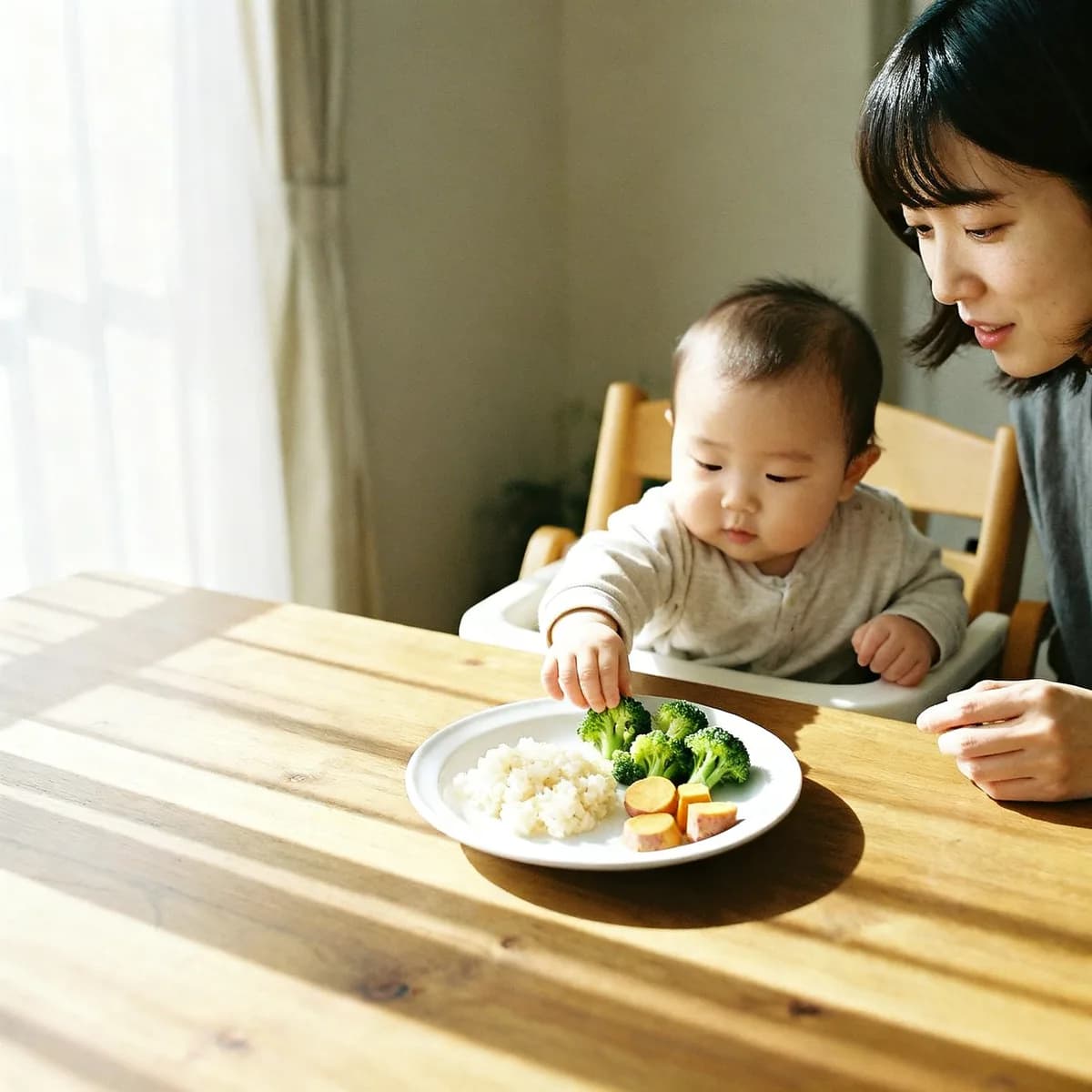
Then there’s the grasp. The raking grasp — where they sweep food toward themselves with their whole hand — is one of the clearest signs baby is ready for table food in a practical sense. It shows intent. They want the food and they’re starting to figure out how to get it.
The AAP recommends waiting until around six months and looking for all of these physical markers together, not just age alone.
Watch their jaw too. Can they move it up and down in a kind of mashing motion? That’s the beginning of chewing. Babies who only suck aren’t equipped to handle texture yet, even soft texture.
And once they’re mobile and curious about everything at the table, it’s worth thinking ahead — a baby proof kitchen becomes a real priority right around this same stage.
These milestones aren’t arbitrary. They exist because your baby’s body has to be mechanically capable before the adventure of real food begins safely.
Here’s the thing nobody really warns you about: right around the time your baby is genuinely ready for food, they get ravenous. Like, feed-me-every-hour ravenous.
It feels like a growth spurt. Sometimes it is. But if it’s been going on for a week or two and your milk or formula just isn’t cutting it anymore, that’s your baby’s body telling you something real.
Watch for a cluster of things happening at the same time — not just one in isolation. Increased feeding frequency is one piece. Hand-to-mouth exploration is another. You’ll notice your baby bringing everything to their mouth with real intention, not just random mouthing. They’re practicing.
The one that matters most? The extrusion reflex fading. That’s the automatic tongue-thrust that pushes foreign objects out of the mouth. It’s a protection mechanism — brilliant in a newborn, but it has to go before solid food makes sense. When it’s gone, food actually stays in instead of getting pushed right back out.
These three signals together — the hunger surge, the hand-to-mouth curiosity, the loss of that reflex — are some of the clearest signs baby is ready for table food. Not just interested in watching you eat. Actually ready, physically and neurologically, to start handling something beyond milk.

Watching your baby grab for your fork and stare you down at dinner is cute. But genuine readiness runs deeper than that. It’s a whole-body shift, and once you see it, you’ll know the difference.
And if you’re already thinking ahead to the bigger milestones coming — the independence, the transitions — it’s never too early to read up on preschool readiness signs. This season goes faster than you think.
Here’s the one that gets you. You’re sitting down to eat and your baby locks eyes with your fork like it personally offended them.
That reaching? That leaning forward, mouth open, tracking every bite you take? That’s not random. That’s your baby telling you something.
One of the clearest signs baby is ready for table food is this mealtime fascination — not just glancing over, but full-on watching. They follow the spoon from bowl to mouth. They reach toward your plate with real intention. They get visibly frustrated when you don’t share.
It’s social, not just physical. Your baby wants to be part of what’s happening at the table. They’re picking up that eating is something people do together, and they want in.
Watch for these specific behaviors:
They reach and grab — not swatting, but actually directing their hand toward food or utensils. They open their mouth when they see you eating, almost like they’re practicing. They get excited or agitated when they smell food nearby.
Some babies will stare so hard you feel guilty finishing your meal. That intensity is information. It means their brain is connecting the dots — food exists, people eat it, I want some.
You’ll also notice a shift in how they respond to you eating versus other activities. A toy might hold their attention for a minute. Your dinner? They’ll track it the entire meal without losing interest.
That kind of focused, sustained curiosity is different from general nosiness. It’s purposeful. And it usually shows up right around the same time the physical readiness cues do — which is why it’s worth paying attention to the whole picture, not just one signal in isolation.
Your baby isn’t being dramatic. They’re communicating. And honestly, they’re pretty good at it.
Here’s the thing about baby feeding gear — the market is overwhelming and most of it is noise.
What you actually need is pretty simple. A high chair that keeps your baby upright at 90 degrees, with feet supported. That position matters more than any fancy tray or insert.
Skip the forward-facing reclined bouncers for mealtime. Upright means safer swallowing, less gagging, better control. That’s the whole game at this stage.
For utensils, a short-handled silicone spoon and a suction bowl are genuinely useful — not because they’re cute, but because they reduce the chaos enough that your baby can actually focus on eating.
Portion sizes throw a lot of people off. Think small. Like, embarrassingly small. A piece of soft food about the size of your pinky fingertip is a real starting portion. You’re not feeding them a meal yet — you’re teaching them a skill.
The stuff you don’t need: special “first food” kits, elaborate storage systems, electric food warmers. A fork and a little time do the same job.
One thing worth knowing — if your baby has shown any signs of sensitive skin or reactions, Beemymagic is worth having on hand before messy meals become a daily thing, because food on new skin can sometimes cause irritation you weren’t expecting.
Always stay within arm’s reach during any table food session. No exceptions, no multitasking, no stepping away “just for a second.”
Gagging is normal. Choking is different. Learning to tell the difference before you start — not in the middle of a meal — will save you a lot of panic.
The right setup doesn’t need to be expensive. It just needs to be intentional.

Here’s something nobody tells you enough: the calendar doesn’t decide when your baby is ready. Your baby does.
Turning six months old is a starting point, not a finish line. Some babies get there and need a few more weeks. That’s not a problem. That’s just your baby telling you something.
The AAP recommends watching for specific readiness signs before introducing solids — including the ability to sit upright with minimal support and showing interest in food. Both matter. A lot.
If your baby slumps forward in the high chair, that’s a real signal. Sitting upright isn’t just about posture — it’s about keeping the airway in the right position to swallow safely. Pushing table food before that muscle control is there creates a genuinely harder experience for everyone.
Gagging constantly — not the occasional gag, but every single bite — is worth paying attention to. A little gagging is normal and protective. A lot of gagging is your baby’s body saying the coordination isn’t quite there yet.
Difficulty moving food to the back of the mouth, turning the head away consistently, or seeming distressed rather than curious at mealtimes — those are all worth noting.
None of this means something is wrong. It means your baby needs more time. Waiting two or three extra weeks is not falling behind. It’s listening.
The stress you feel when every meal is a battle? That’s often a sign the timing was just a little off. Back up, try again in a week, and watch how different it feels.
If you’ve got a lot of new transitions happening at once — a new childcare routine, for instance — that can affect how a baby tolerates new experiences including food. The first day of daycare guide covers that adjustment period really well if you’re navigating both at once.
Nobody tells you that the transition from purees to real food isn’t a straight line. It loops back. It stalls. It sometimes goes backwards for a week and then suddenly clicks.
Here’s what I know: most babies start purees somewhere between 4 and 6 months, and the move toward soft finger foods usually starts showing up around 8 to 10 months. But that window is wide for a reason.
The clearest signs baby is ready for table food aren’t about age. They’re about behavior. Is your baby reaching for what’s on your plate? Chewing the puree instead of just swallowing it? Picking up objects and bringing them to their mouth with some control? Those are the real green lights.
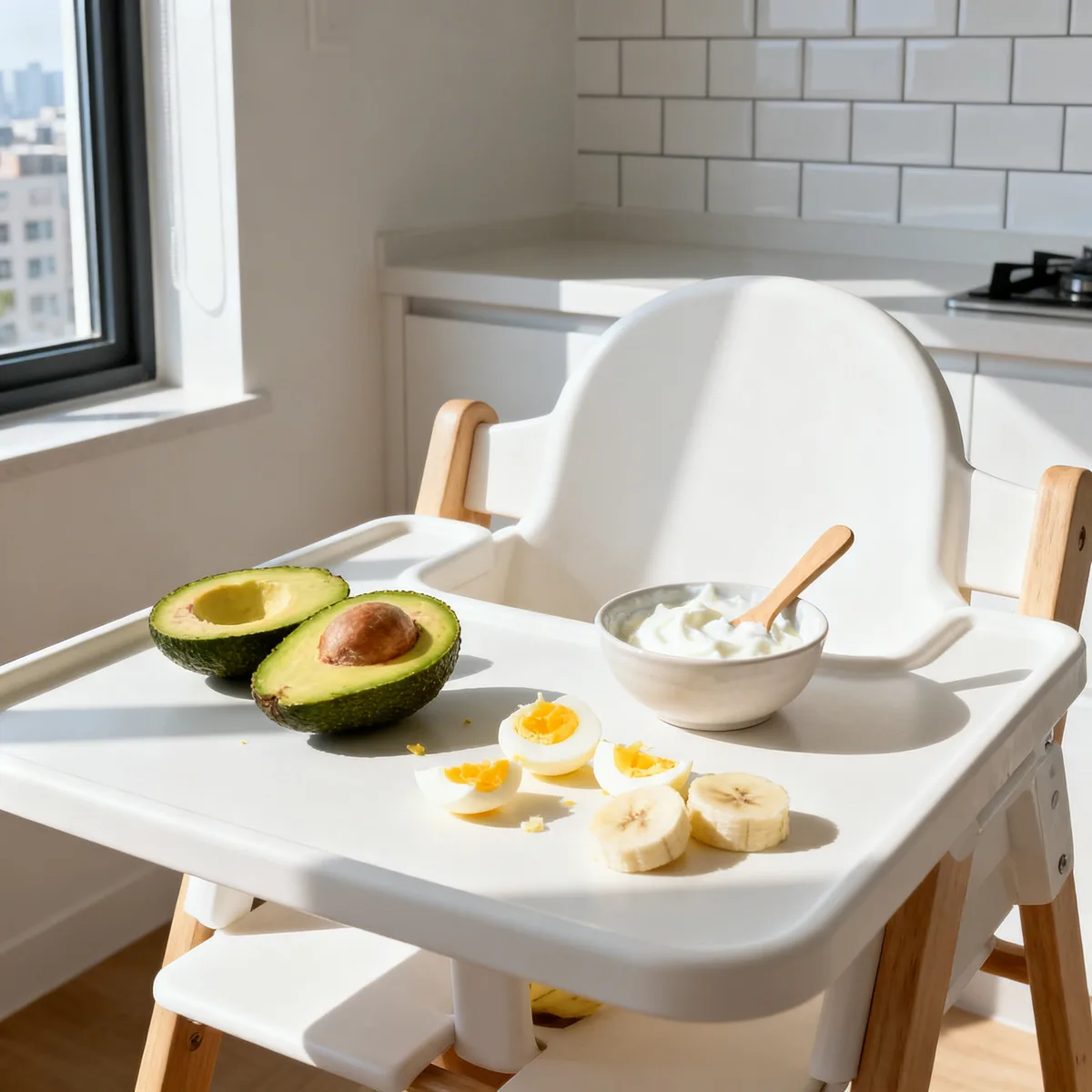
The soft finger food stage is your bridge. Think small pieces of ripe banana, cooked carrot, soft-cooked pasta, scrambled egg. Nothing firm. Nothing round enough to roll into their airway. You’re not skipping purees — you’re just adding texture alongside them.
From there, family meals happen gradually. A bite of what you’re eating. A little of what’s on your plate. You don’t need a separate baby menu forever. That’s actually the goal — to work your way out of making separate meals entirely.
Give each new texture a real runway. A few days minimum. Sometimes a week. If something gets rejected three times in a row, set it aside and come back in two weeks. Palates change faster than we expect at this age.
And if mealtimes are starting to feel like a daily battle that’s wearing you down, that exhaustion is real — it’s worth reading about mom burnout, because feeding stress is one of the quieter ways it creeps in.
Slow is not behind. Slow is just how this one actually works.
Interest alone isn’t enough — your baby needs the physical skills to handle it safely. At five months, check for sitting ability with minimal support, loss of the tongue-thrust reflex, and a raking grasp before offering anything beyond breast milk or formula. If those markers are there, earlier introduction can work; if not, waiting a few weeks is the safer call.
Gagging is actually a protective reflex and very common when babies first try solids — it’s not necessarily a red flag. However, if your baby is consistently struggling to swallow, seems uncomfortable, or shows signs of distress beyond normal gagging, hold off and try again in a week or two. Persistent difficulty swallowing is a sign to wait.
Start with soft, mashable foods like ripe banana, avocado, sweet potato, and well-cooked carrots cut into small pieces. Avoid anything hard, sticky, round, or small enough to fit through a toilet paper tube — those are choking hazards. Single-ingredient foods also make it easier to spot any allergic reactions.
Baby-led weaning is an approach to introducing solids where babies self-feed finger foods instead of eating purees. It’s not the same as readiness — your baby still needs the same physical milestones (sitting, loss of tongue-thrust reflex, grasp) regardless of whether you’re using purees or finger foods. The readiness markers come first; the method comes second.
Reaching for food is one sign of behavioral interest, but it’s not the whole picture. Your baby also needs to sit upright safely, have lost the tongue-thrust reflex, and show coordinated swallowing. Reaching is part of the readiness cluster, but it works alongside physical development — not instead of it.