


Newborn: 0–3 Months
Baby Witching Hour: Why Evenings Are So Hard and How to Actually Cope
Laeeka Edries·13 min read

First-time parent's guide to newborn hearing screening: when it happens, how the test works, what results mean, and why early detection matters for language development.
Here’s what nobody tells you in those first foggy days after birth: that little hearing screen they run before you leave the hospital? It’s one of the most important things that happens in that whole stay. Hearing loss is one of the most common conditions present at birth — and you often can’t tell just by watching your baby respond to your face or startle at vibrations. A newborn hearing test catches what you can’t see, and the timing matters more than most people realise.
The brain’s language pathways are forming fast in those first months, and they need sound input to develop properly. This guide walks you through why your newborn’s hearing screening happens, what actually occurs during the test, how to read the results, and what to do if your baby needs follow-up care.
Here’s something nobody tells you in those first foggy days after birth: that little hearing screen they run before you leave the hospital? It’s one of the most important things that happens in that whole stay. And it’s easy to wave it off as routine — just another test, another clipboard, another thing to get through. But it’s not routine. It actually matters.
Hearing loss is one of the most common conditions present at birth. And the thing about it is — you often can’t tell. Babies respond to movement, to warmth, to your face. They startle at vibrations. A baby with significant hearing loss can seem perfectly responsive for months before anyone notices something is off.
That window matters more than most people realise. The brain’s language pathways are forming fast in the first months of life — and they need sound input to develop properly. The AAP recommends that all newborns be screened for hearing loss before one month of age, diagnosed by three months if there’s a concern, and enrolled in early intervention services by six months. That’s the 1-3-6 model, and the research behind it is clear: babies who get support within that window have significantly better language and cognitive outcomes than those who don’t.
Without early detection, the gap widens quietly. Speech delays. Reading difficulties. Challenges in school that trace back to those first undetected months. None of that is inevitable — but it becomes much harder to address the longer it goes unnoticed.
So if your newborn’s hearing screen comes back with a flag, try to breathe. A referral isn’t a diagnosis. It just means look closer. And looking closer early is exactly what you want to do. You’re already doing the right thing by paying attention — that’s how this works.
Here’s the thing nobody warns you about — the hospital doesn’t slow down after birth. There’s a lot happening in those first 48 hours. Feeding attempts, visitors, nurses coming in at all hours, your body doing its own wild recovery. And somewhere in the middle of all of that, the newborn hearing test quietly gets done.
Most hospitals screen before you even leave. That’s the goal. If your baby is born in a facility that offers newborn screening — and most do — the test typically happens within the first day or two of life. It takes just a few minutes. Your baby doesn’t need to be awake or cooperative. They just need to be still, which is why it’s often done while they’re sleeping.
If for any reason it doesn’t happen in the hospital — maybe your baby was in the NICU, or you had a home birth, or something got missed in the shuffle — the window doesn’t slam shut. The standard recommendation is to complete screening by one month of age. That’s your breathing room.
Why does that early window matter so much? Because the first few months are when your baby’s brain is doing the most intense wiring for language and sound. Every coo, every voice, every lullaby you sing — it’s all input that shapes how their auditory system develops. If something is off, catching it now means you can support that development right alongside it, not years later when the gap has grown.
You’re navigating so much in those early weeks — newborn sleep schedule chaos, feeding around the clock, figuring out your own new normal. The hearing screen is one thing that genuinely doesn’t need to fall through the cracks. It’s quick, it’s painless, and the timing really does matter.
There are two methods you’ll likely encounter, and both are completely painless. Your baby doesn’t need to do anything. They don’t even need to be awake.
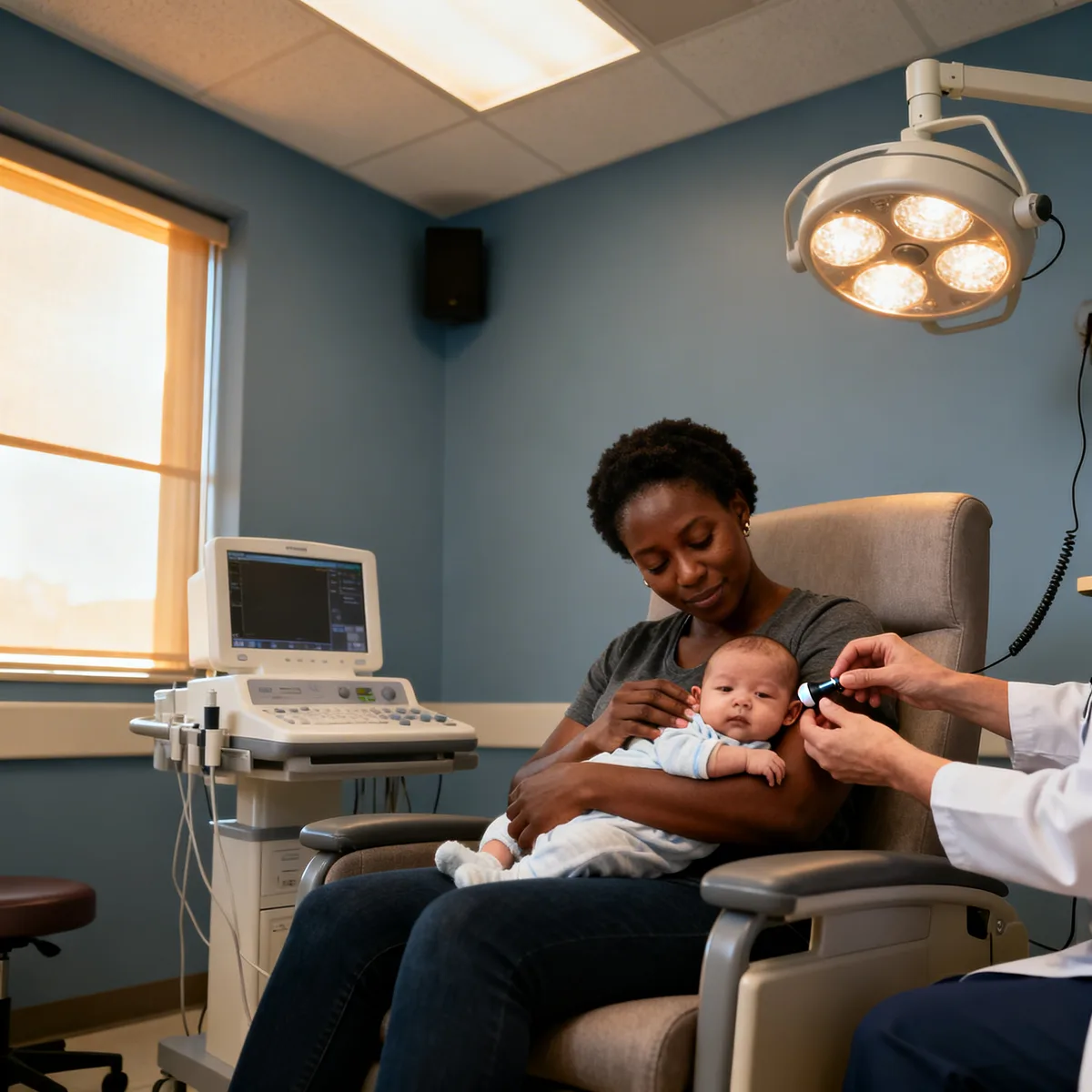
The first is the OAE — otoacoustic emissions test. A tiny probe is placed in your baby’s ear canal. It sends soft sounds in, then measures whether the inner ear (the cochlea) echoes them back. A healthy cochlea responds. If it doesn’t, the test flags it. It takes a few minutes. You’ll probably just be watching your baby sleep through the whole thing.
The second is the ABR — auditory brainstem response test. This one goes a step further. Small sensors are placed on your baby’s head, and it measures how the auditory nerve and brainstem actually respond to sound. It’s not just checking whether the ear receives sound — it’s checking whether the signal travels correctly to the brain. Some hospitals use this as the primary screen. Others use it as a follow-up if the OAE flags anything.

The AAP recommends that all newborns have their hearing screened before they leave the hospital — ideally within the first month of life — because early identification and intervention for hearing loss leads to significantly better language and developmental outcomes.
Here’s what to expect in the room: it’s quiet, it’s calm, and the technician works around your baby rather than disturbing them. If your baby is fussy, they may wait for a settled moment. A “refer” result — meaning they need a retest — doesn’t mean something is wrong. It’s common. It just means the screen needs to be repeated under better conditions.
If your mind is also spinning with feeding questions right now, our piece on breastfeeding tips covers a lot of what those early weeks actually look like.
Here’s the thing nobody tells you: the newborn hearing test is one of the gentler things that happens in those first couple of days. You’re often running on no sleep, still processing the birth, and then someone comes in with equipment and you brace yourself. But this one? It’s genuinely calm.
Most hospitals do the screen before you’re discharged — usually within the first 24 to 48 hours. You’ll either stay in your room or walk to a small, quiet space nearby. Either way, you’re with your baby the whole time.
The technician will place tiny soft earphones over your baby’s ears and small sensors on their head. That’s it. No needles. No loud sounds. Nothing that will startle them.
The whole thing takes around 5 to 10 minutes, sometimes a little longer if baby needs to settle. And here’s the key part — your baby doesn’t need to be awake. Actually, sleeping is ideal. A drowsy or deeply asleep baby gives the clearest results. So if you’ve just finished a feed and they’ve drifted off, that’s genuinely perfect timing. If you’re in those early days of figuring out feeding, our piece on newborn cluster feeding day 2 can help you understand why baby might be feeding constantly right now — and how to work with it.
The equipment measures how the inner ear responds to soft sounds. The technician watches the readings. You watch your baby. Nobody’s rushing.
If your baby stirs or gets fussy, the technician will usually pause and wait. They do this all the time. They’re not bothered. You don’t need to stress about keeping baby still or perfectly quiet.
The whole experience is designed to work around your newborn — not the other way around. That’s worth knowing before you walk in.
The results come fast. Sometimes before you’ve even finished getting your baby dressed again. And when the word “refer” shows up instead of “pass,” your stomach drops. I know that feeling. So let’s talk about what these words actually mean — because “refer” is not the word you think it is.
A pass means the equipment detected a clear response from your baby’s inner ear. Good news, straightforward result. A refer means the screening didn’t get a clean enough reading to confirm a pass. That’s it. It does not mean your baby has hearing loss. It means the test needs to be repeated under better conditions.
Here’s what actually causes a refer result most of the time: fluid in the ear canal from birth, a fussy or restless baby, background noise in the room, or just timing. Newborns are brand new. Their ears are still clearing out. A refer on day two of life tells you very little about what’s actually going on with their hearing.
The AAP recommends that all babies who receive a refer result complete follow-up diagnostic testing by three months of age — and that if hearing loss is confirmed, intervention begins by six months. That timeline matters. Early support makes a real difference in speech and language development. But notice that three-month window. You have time. You’re not behind.

If you’re sent for a follow-up, the next test is usually an ABR — an auditory brainstem response test. It’s more detailed than the newborn hearing test done at the hospital, and it gives audiologists a much clearer picture. Most babies who get a refer at birth pass that second screening without any issues.
A refer is a flag, not a finding. There’s a big difference. Follow the follow-up. Ask your questions. But don’t let one word on a form tell you a story that hasn’t been written yet.
Walking into that appointment with a list of questions is one of the best things you can do for yourself. Not because you need to know everything — you don’t. But because asking out loud helps you understand what’s actually happening, not just what a form says.
Here’s what’s worth asking, broken down by when:
Before the test:
Right after:
If you’re sent for follow-up:
One more thing worth knowing: your pediatrician is your ally here, not just a gatekeeper. If you feel rushed or dismissed, it’s okay to say “I need a minute” or “can you explain that differently.” You’re not being difficult. You’re being a mom.
And if you’re navigating a lot of newborn health questions all at once — hearing, feeding, digestion — you’re not alone. Things like newborn reflux can feel just as overwhelming in those early weeks. One question at a time. You’ll get there.
No, your baby doesn’t need to be asleep, but they do need to be calm and still. The quieter and more settled your baby is, the easier it is for the audiologist to get a clear reading. Many hospitals time the screening during sleep because babies are naturally more still, but a drowsy or content awake baby works fine too.
A ‘refer’ result means the test didn’t get a clear result and your baby needs follow-up testing — it is not a diagnosis of hearing loss. This can happen for many reasons, including fluid in the ear, movement during the test, or simply needing a more detailed assessment. About 2–4% of newborns receive a refer result, and many pass when retested.
Newborn screening tests are highly sensitive and catch most cases of hearing loss present at birth, but they’re not 100% perfect. Some babies with mild hearing loss or hearing loss that develops after the newborn period may not be caught at screening. This is why ongoing monitoring during well-child visits is important, and why you should report any concerns about your baby’s response to sound to your pediatrician.
Newborn hearing screening tests are very accurate — typically 90–99% depending on the method used. OAE and ABR tests are non-invasive, quick, and reliably identify significant hearing loss. However, accuracy depends partly on how well your baby cooperates and how much outside noise is in the room during testing.
If your baby receives a refer result, your pediatrician will recommend follow-up testing, usually with an audiologist, ideally by 3 months of age. The follow-up will likely be more detailed and may include additional tests to confirm whether hearing loss is present. Many babies who don’t pass the initial screening have normal hearing on follow-up — fluid or positioning during the first test is a common reason for a refer.