

Buying Guides
Best Portable High Chair for Travel: Reviews & Buying Guide for On-the-Go Feeding
Soyeon Park·11 min read

An honest first-person breakdown of Korean baby products worth buying — what actually held up, what I returned, and exactly why. No fluff.
Here’s what nobody tells you about the K-Baby rabbit hole: it’s deep, it’s expensive, and the aesthetic alone will have you clicking “add to cart” on things your baby does not need. I’ve been there. I am that person. And after two kids and more packages from Korean baby brands than I’d like to admit, I have opinions. Real ones. The kind that include return labels and a few genuine holy-grail finds that I now buy for every new mom I know. This is that list — the keepers, the returnees, and the exact reason I sent stuff back. Because “Korean baby products worth buying” is only useful information if someone’s actually willing to tell you which ones aren’t.
It’s not hype for the sake of hype. Korean baby brands have spent decades engineering for a market that is genuinely obsessive about infant safety and material standards. PPSU instead of standard plastic. Fragrance-free formulations as the default, not the premium tier. Ergonomic feeding designs built around infant oral development, not just “looks cute on the shelf.” The standard is different. That doesn’t mean every product clears the bar — but it does mean the bar is higher to begin with.
That said, the overlap between “Korean baby product” and “overpriced aesthetic object” is very real. I’ve bought from both categories. Here’s how I tell them apart now.
I resisted this one for longer than I should have. It looked like every other straw cup. Same size, similar shape, higher price point. Then my first kid turned 12 months and our pediatrician mentioned the AAP’s guidance on transitioning away from bottles — specifically that open cups and straw cups support oral motor development better than sippy cups with spout valves. I started looking more seriously at what my kid was actually drinking from.
The Grosmimi PPSU Straw Cup is made from polyphenylsulfone — BPA-free, phthalate-free, and rated to withstand repeated sterilization without degrading the way standard plastic does. The straw mechanism is genuinely leak-resistant in a way that other cups I’d tried were not. More importantly, my kid could actually use it without a meltdown learning curve, which at 13 months is the only product review that matters. We’re on our second kid now and own three of them. If you’re trying to find the one that survives a real house, the Grosmimi PPSU Straw Cup 10oz available at Onzenna is it.
A smaller Grosmimi bottle we tried with our newborn didn’t work for us. The nipple flow rate felt fast for our baby, who was combo-feeding and already dealing with some bottle preference issues. That’s not a flaw in the product — flow rate is deeply personal to each baby’s suck pattern — but I want to name it because “Grosmimi is great” without “here’s a situation where it wasn’t right for us” is not useful information. If your baby is a slow feeder or combo-feeding, check the nipple flow rate before you commit. We returned it and went back to what was already working. No drama.
My first kid had reactive skin. Not diagnosed eczema, but the kind of skin that screamed at anything with fragrance, dye, or a long ingredient list. I went through an embarrassing number of “gentle” baby washes before I started reading ingredient labels instead of marketing copy. Most mainstream “sensitive” baby products still contain parfum, synthetic preservatives, or botanical extracts that can irritate compromised skin. The AAP recommends fragrance-free, dye-free products for babies with sensitive or eczema-prone skin — a recommendation most “natural” baby brands technically fail.
Cha&Mom is formulated with that standard as the starting point. The wash and lotion are fragrance-free, dermatologically tested, and designed for the kind of skin that rejects most things. My second kid has better skin than the first, and I genuinely do not know how much of that is biology versus the fact that I switched immediately to Cha&Mom from birth. Either way, I’m not changing anything. The Cha&Mom Essential Duo Bundle at Onzenna is what I give at baby showers now instead of the pastel-packaged stuff everyone else brings.
Honestly? Nothing yet. But I’ll tell you the caveat: if your baby has a diagnosed skin condition, you’re not shopping blog recommendations — you’re talking to your pediatric dermatologist. Cha&Mom is well-formulated for sensitive skin. It’s not a treatment. I want to be clear about that line because “fragrance-free Korean skincare” can start to sound like a medical solution, and it isn’t. It’s just a genuinely clean baseline, which is more than most products offer.
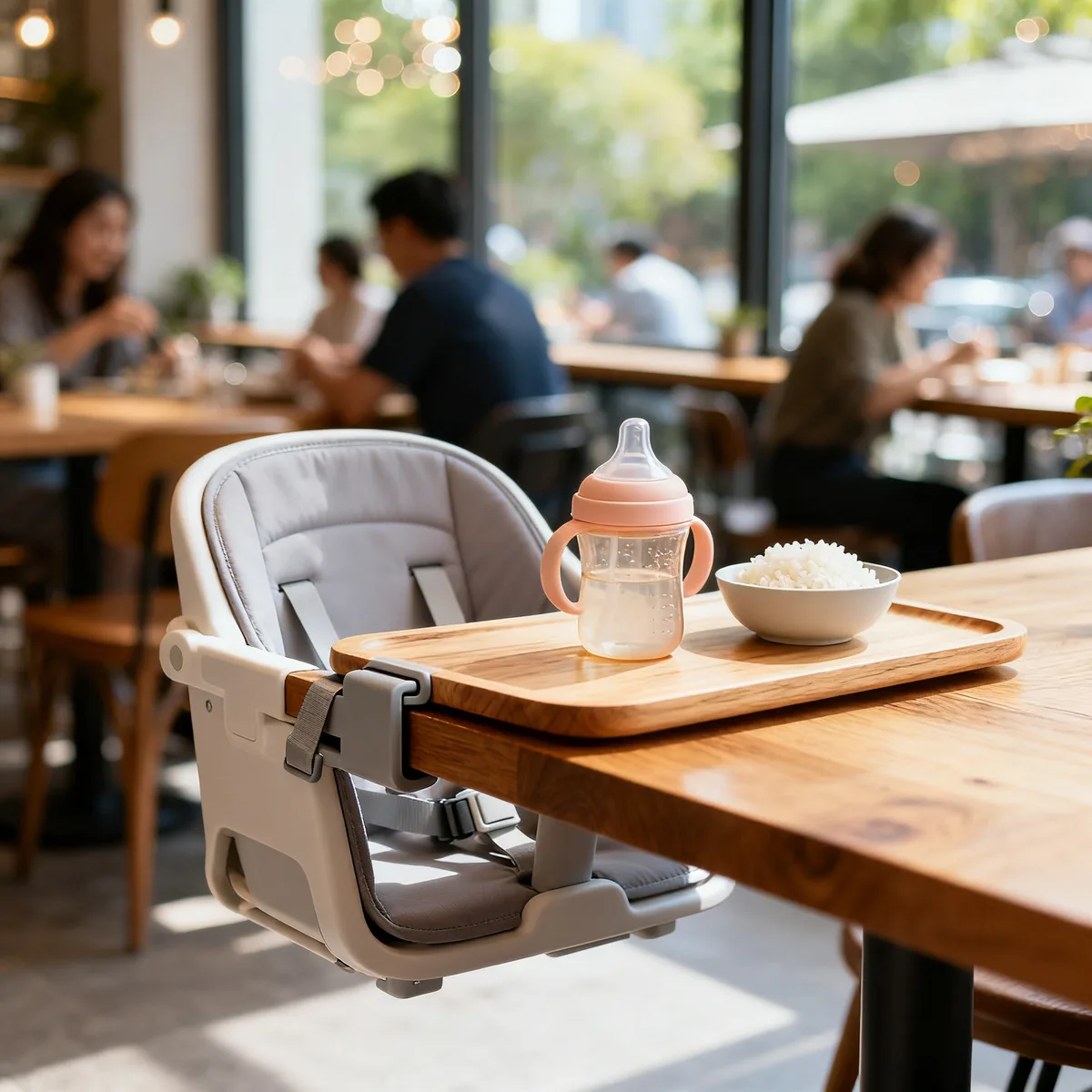
Feeding a baby who has opinions about sitting upright is a full-contact sport. We tried two different generic booster seats before the Alpremio. Both had the same problems: hard to clean, tilted at a weird angle, and somehow made the whole feeding situation feel more chaotic rather than less. The Alpremio infant feeding seat is designed with back support and a seated angle that’s actually appropriate for babies who are starting solids — which matters more than most people realize when you’re trying to establish safe swallowing mechanics in a kid who’s been horizontal for six months.
What I noticed immediately: my kid stopped slumping. Sounds small. It is not small when you’re doing three meals a day and you’re also trying to not lose your mind. The seat is easy to wipe down, buckles securely onto a dining chair, and does not have seventeen pieces that you’ll lose by week two. I’ve had it for eight months. Still using it. Still have all the pieces. You can find it in the Infant Feeding Seats collection at Onzenna.
There was a Korean baby snack I ordered — beautifully packaged, clearly high quality, the kind of thing that makes you feel like a very intentional parent just for purchasing it. My kid took one bite and looked at me like I had personally wronged them. Spit it out. Pushed the container off the tray. Moved on with their life. That’s not a product failure. That’s a toddler. But I returned what I hadn’t opened because we weren’t going to use it, and I want you to know that’s allowed. Good packaging is not a guarantee of a good fit for your specific, chaotic, opinionated small person.
Buy the things that solve real problems in your actual life. Return the things that don’t. Korean baby brands, on the whole, earn more keeps than returns in my house. But no brand is batting a thousand.
Here’s the filter I use now, after two kids and enough returned packages to know better:
Korean baby brands tend to pass more of these checks than most. That’s why the reputation exists. But the reputation doesn’t do the vetting for you — you still have to ask the questions.
More in Korean Baby Products
“Safer” is complicated. Korean baby brands often apply stricter material standards — PPSU over standard plastic, fragrance-free as a default — than many mainstream Western brands. But safety depends on the specific product and how it’s used. Look at materials, certifications, and whether the design rationale is explained. Don’t assume the label does that work for you.
In our experience, yes — specifically because PPSU holds up to repeated sterilization without degrading the way standard plastic does, and the leak-resistance is genuine, not just marketing. Whether that’s worth it to you depends on how much you sterilize and how much a leaky cup in your bag costs you in sanity. For us: worth it.
Cha&Mom products are formulated for sensitive infant skin, but as with any new product, patch-test first — especially if your baby has a known skin condition. If your baby has diagnosed eczema or a dermatological condition, loop in your pediatrician or pediatric dermatologist before introducing any new skincare, regardless of brand.
Most babies are ready to begin solid foods around 6 months, when they can hold their head up steadily and show interest in food — but your pediatrician should confirm readiness for your specific baby. A supportive feeding seat is most useful once you’re doing regular solid meals and need your baby to be in a stable, upright position for safe swallowing.
Look for specific material disclosures (not just “BPA-free” — what is it made of?), functional design explanations, and dermatological or safety testing information. Great packaging on a product with vague claims is a flag. Great packaging on a product that can explain exactly why it’s designed that way is usually the real thing.