


Newborn: 0–3 Months
Baby Witching Hour: Why Evenings Are So Hard and How to Actually Cope
Laeeka Edries·13 min read

Learn how infant massage relieves gas and improves sleep. Step-by-step techniques, safety guidelines, and what research actually shows about colic relief.
Here’s what most parents don’t realize about infant massage: it’s not a cure for colic, but it’s one of the few things you can actually do with your hands that changes your baby’s nervous system in real time.
Gentle abdominal massage stimulates peristalsis—the wave-like muscle contractions that move gas through your baby’s digestive tract. When your newborn’s gut muscles are still immature, gas gets trapped. Massage physically helps move it along, and research shows it can reduce crying duration, improve sleep quality, and lower stress hormones in your baby’s body.
This guide walks you through evidence-based infant massage techniques for gas relief, colic management, and better sleep—plus exactly when, how long, and how hard to massage so you’re actually helping, not adding to the overwhelm.
Here’s the honest truth: there’s no magic cure for colic. If you’ve spent nights bouncing a screaming baby wondering what you’re doing wrong, I want you to hear that first.
That said, touch is genuinely powerful. Gentle abdominal massage moves gas through your baby’s digestive tract by stimulating peristalsis — that’s the wave-like muscle movement that keeps things flowing. When those muscles are immature, gas gets stuck. Massage can physically help move it along.
The research on colic is more complicated. Studies show that infant massage can reduce crying duration in some babies, but it’s not a guaranteed fix — especially for true colic, which has multiple possible causes. What it reliably does is regulate your baby’s nervous system, lower cortisol levels, and improve sleep quality over time.
The AAP recognizes that skin-to-skin contact and gentle touch support healthy infant development, including improved weight gain in premature babies and better sleep patterns in newborns.
So think of massage less as a treatment and more as a tool. It lowers the overall stress load on your baby’s system. A calmer nervous system tends to mean a calmer gut. That’s real, even if it’s not instant.
If you want to try it for gas specifically, fragrance-free baby massage oil — it makes a real difference in how the technique lands.
And if you’re still trying to figure out whether what you’re dealing with is actually colic, this breakdown of the signs of colic is worth reading before you go any further. Knowing what you’re working with changes everything.
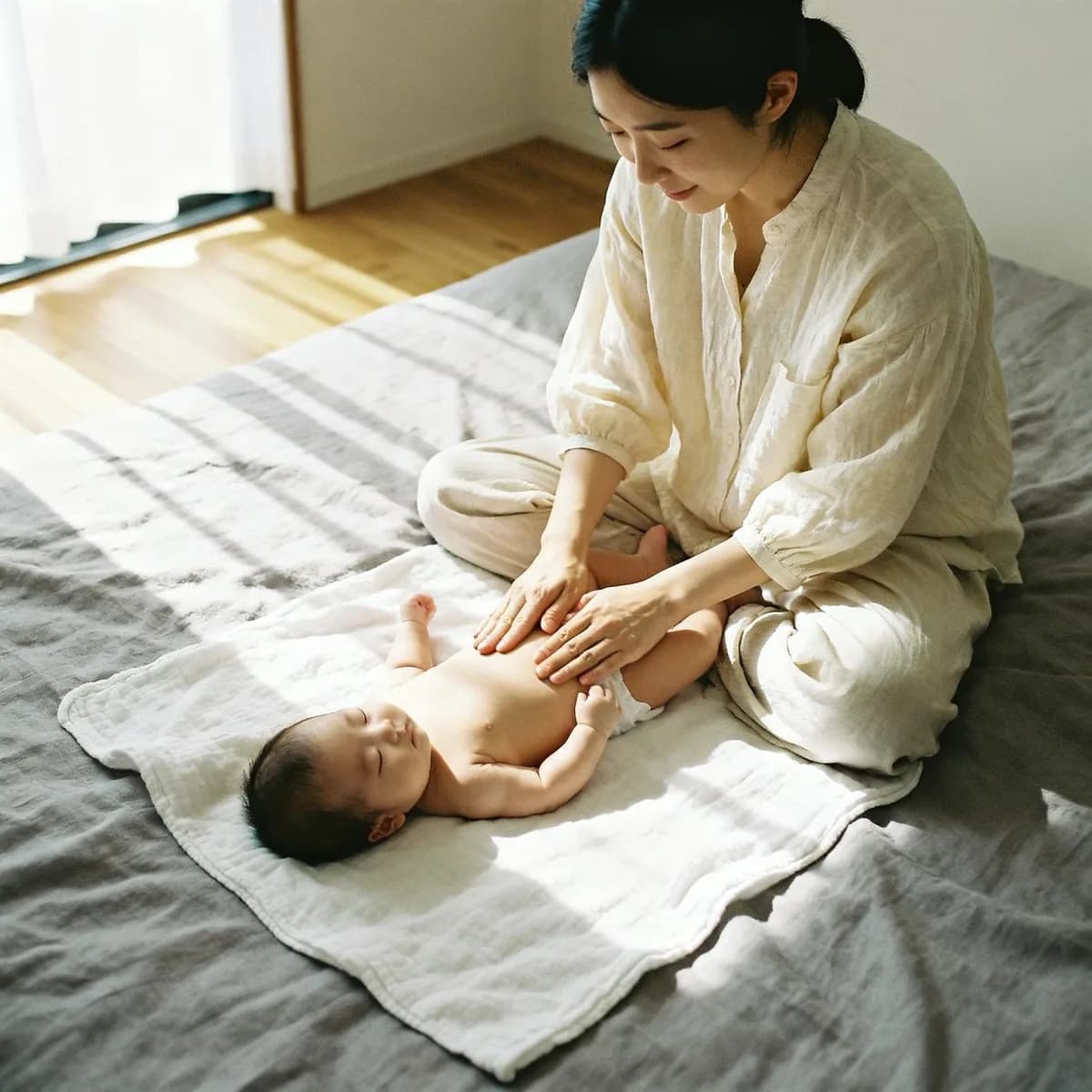
Before you start, make sure your baby is calm — not mid-cry, not starving, not just fed. Somewhere in between. A relaxed baby will actually let you in.
Warm a small amount of fragrance-free oil between your palms first. Cold hands on a baby belly will tense everything up, and that’s the opposite of what we want.
Now here’s the key thing to understand: your baby’s colon moves in a specific direction. Clockwise, when you’re looking at them. That’s the path gas needs to travel to get out. Your hands are just going to help it along.
Start with both hands flat on the belly, just below the ribcage. Use gentle, steady pressure — firm enough to feel, light enough that you could hold it there all day without effort.
Move your right hand in a slow arc across the belly from left to right (your left to right — their right to left). Then bring your left hand up to meet it and continue the circle downward. Keep going — you’re tracing the shape of an upside-down U, over and over.
Ten circles, slow. Then pause. Watch their face. If they’re softening into it, keep going. If they’re tensing or crying, stop — their body is telling you something.
This is the heart of infant massage for gas relief. It looks simple because it is. But consistency matters more than perfection here.
Some babies pass gas within a minute. Some take a few sessions before their body starts responding. If sleep disruption is also part of what you’re dealing with, it’s worth knowing that gas and overtiredness often compound each other — understanding the 3 month sleep regression can help you separate what’s digestion and what’s developmental.
Do this once or twice a day. Before a bath works well. Make it a ritual, not a rescue mission.
Watching your baby arch and cry from trapped gas is one of those things nobody really prepares you for. You’d do anything to help them. Here’s what actually works.
Leg cycling is exactly what it sounds like. Lay your baby on their back, hold their ankles gently, and move their legs in a slow, smooth pedaling motion — like they’re riding a tiny bike. Do this for about 30 seconds, then rest. Repeat a few times.

The movement compresses the abdomen in a rhythmic way that helps push trapped air through the digestive tract. You’ll sometimes hear — or smell — results pretty quickly.
The I-Love-U massage takes a little more intention, but it’s worth learning. You’re tracing letters on your baby’s belly with two fingers, using gentle but firm pressure.
Start with a single downward stroke on their left side — that’s the “I.” Then trace an upside-down “L,” going across the top of the belly and down the left side. Finally, trace an upside-down “U,” going up the right side, across, and down the left.
You’re following the path of the large intestine. The direction matters — always move left to right across the top, always finish on the left side going down.
Both techniques work best when your hands can glide without friction — fragrance-free baby lotion. Cold hands on a tense baby belly helps no one.
Infant massage in general builds something beyond gas relief — it builds body awareness and trust. Your baby starts to associate your touch with comfort, not just crisis.
Do both techniques together. Cycle the legs, then go into the I-Love-U. Give it two full rounds before you move on.
Here’s something nobody tells you: the belly work is just the beginning.
Your baby’s nervous system is still figuring out how to power down. That frantic, wide-eyed, can’t-settle energy at the end of the day? That’s an activated nervous system that hasn’t found the off switch yet.
Full-body touch is how you help flip it.
When you move slowly and deliberately — legs, arms, chest, back — you’re stimulating the parasympathetic nervous system. That’s the “rest and digest” side of things. It signals to your baby’s body: we’re safe, we can slow down now.
Start at the legs. Long, slow strokes from thigh to foot. Don’t rush it. Then the arms — wrap your hand around their upper arm and glide down to their wrist. Let the pressure be firm enough to feel like contact, not so light it’s ticklish.
The chest is powerful. Flat palms, moving outward from the center like you’re opening a little book. Some babies melt immediately. Some need a few rounds before they trust it.
Then flip them — tummy-down on your lap or a firm surface — and do the back. Side-to-side strokes across the width, then long strokes down the spine. This is often where you’ll feel them go heavy.
The AAP recognizes that positive touch and skin-to-skin contact support healthy neurological development in infants — and a calmer nervous system is a baby who reaches deeper, more restorative sleep cycles.
If you’re working on a one month old sleep schedule, this kind of routine can anchor the wind-down in a way that actually sticks — because it’s physical, not just environmental.
The whole sequence takes maybe seven minutes. That’s it. Seven minutes that tells your baby, with your hands, that the day is done.
The timing matters more than most people think. The sweet spot for infant massage is about 30 to 45 minutes after a feed — not before, not right after. A full belly and a flat back are not a good combination.
Bedtime is the other window that works really well. It pairs naturally with a bath-and-wind-down routine, and your baby’s nervous system is already starting to slow. You’re just helping it along.
As for how long — shorter than you’d expect. Ten to fifteen minutes is plenty for most babies. For newborns, even five minutes is enough. Watch their cues, not the clock.

The AAP notes that regular, gentle touch supports healthy weight gain in preterm infants — which tells you something about how powerful consistent, calm contact really is for a developing body.
Now, the safety part. This is where I want you to slow down and actually read, because it matters.
Never massage over the fontanelle — that soft spot on the top of your baby’s head. It’s not protected by bone yet. Leave it alone completely.
Skip the spine. Work around it, not on it. The back is fine — just keep your strokes on the muscles beside the spine, not directly on it.
If your baby is unwell, has a fever, or has any broken or irritated skin, skip the massage that day. And if you’re ever unsure about a rash or something on their skin, our guide to tiny bumps on newborn skin can help you figure out what you’re actually looking at.
Watch your baby’s face the whole time. Turning away, arching back, fussing — those are stop signals. A baby who’s into it will make eye contact, go soft in the limbs, and sometimes drift off mid-stroke. That’s your green light to keep going.
Here’s what nobody tells you: improvement with gas and colic is slow and uneven. You’re not going to have one good session and suddenly have a different baby.
But here’s what working actually looks like. You’ll notice your baby passing gas more easily during or right after belly work. Their crying windows get a little shorter. They settle faster when you pick them up.
Over a week or two, the tense, rigid belly starts to soften between feeds. That’s a real sign. So is a baby who’s starting to make eye contact during massage instead of turning away — it means their nervous system is calming down, not just in the moment, but overall.
Normal newborn behavior that is NOT a red flag: grunting, straining, turning red while pooping. That’s just how they do it. Their abdominal muscles are new. It looks alarming. It usually isn’t.
The AAP notes that babies typically have one to three bowel movements per day in the early weeks, but some healthy breastfed babies go several days between poops — so frequency alone isn’t a reason to panic.
What IS worth a call to your pediatrician: a hard, distended belly that doesn’t soften between feeds. Vomiting that’s forceful or green-tinged. Blood in the stool. A baby who won’t eat, or who cries inconsolably for more than three hours straight. Those aren’t colic quirks. Those need eyes on them.
Also call if your baby has a fever alongside the crying. Our guide to baby fever can help you figure out what the numbers actually mean for a newborn.
Trust your gut. You know your baby’s baseline better than anyone. If something feels off beyond the usual hard, it probably is.
Yes, gentle infant massage is safe for newborns under 1 month, but approach it carefully. Use minimal pressure, warm your hands first, and avoid the umbilical cord area if it’s still healing. If your baby seems tense or cries during massage, stop immediately—their body is communicating discomfort.
Some babies show relief within minutes of a single massage session, especially for trapped gas. However, colic is complex and multi-factored, so results vary widely. Consistent daily massage over 1-2 weeks is more likely to show cumulative benefits in sleep quality and overall stress reduction than a single session.
Yes to both. Bottle-fed babies benefit from massage just as much as breastfed babies. For reflux, avoid massage immediately after feeding and skip deep abdominal pressure if your baby seems uncomfortable. Timing is key—wait at least 30-45 minutes after a feed before doing belly massage.
The ideal time is 15-30 minutes before bedtime, when your baby is calm but not exhausted. Morning or early afternoon sessions also work well for gas relief. Avoid massage during peak fussy times or when your baby is actively hungry—a calm baby will relax into the touch.
Use gentle, steady pressure—firm enough that your baby can feel it, but light enough that you could hold it there indefinitely without effort. Think of it as the pressure you’d use to test if bread dough has risen, not kneading it. If your baby tenses or pulls away, you’re pressing too hard.