


Trying to Conceive
Signs of Ovulation: What Your Body Is Telling You During Your Fertile Window
Jeehoo Jeon·14 min read

Learn how to track ovulation with basal body temperature, cervical mucus, OPK tests, and apps. Master your fertile window and understand your cycle.
Here’s what nobody tells you about how to track ovulation: most people think it’s complicated, but your body is already broadcasting when it’s fertile — you just need to know what to listen for.
The truth is, how to track ovulation comes down to reading five basic signals: your resting temperature, cervical mucus changes, hormone surges, cycle patterns, and apps that do the math for you. Most people assume ovulation happens on day 14 and call it done. That assumption costs them months of missed windows.
This guide breaks down each method — from basal body temperature to ovulation predictor kits — so you can choose what fits your life and actually understand your fertile window instead of guessing.
Conception is only possible during a narrow window each cycle. According to the CDC, an egg survives just 12 to 24 hours after ovulation — meaning the days immediately before and the day of ovulation are your highest-fertility window.
Sperm can survive in the reproductive tract for up to five days. That gives you a fertile window of roughly six days per cycle, but the two days before ovulation and ovulation day itself carry the highest probability of conception.
Most people assume ovulation always happens on day 14. It doesn’t. Cycle length varies, and ovulation timing shifts with stress, illness, sleep disruption, and hormonal changes. Assuming a fixed date often means missing the window entirely.
This is where understanding how to track ovulation changes the picture. Rather than timing intercourse by a calendar estimate, you’re working from your body’s actual signals — basal body temperature, cervical mucus changes, and luteinizing hormone (LH) surges detectable by urine tests.
Those physical signals are real and readable. You can learn to identify them. The fertile window symptoms article on Onzenna breaks down exactly what to look for and when.
The AAP recommends that anyone trying to conceive track their menstrual cycles as a baseline health practice — cycle data helps both you and your provider identify patterns, irregularities, and the right timing for next steps.
Tracking also reduces the psychological load of uncertainty. When you understand your cycle, you’re making informed decisions rather than guessing. That’s not a small thing — it’s the difference between feeling reactive and feeling in control.
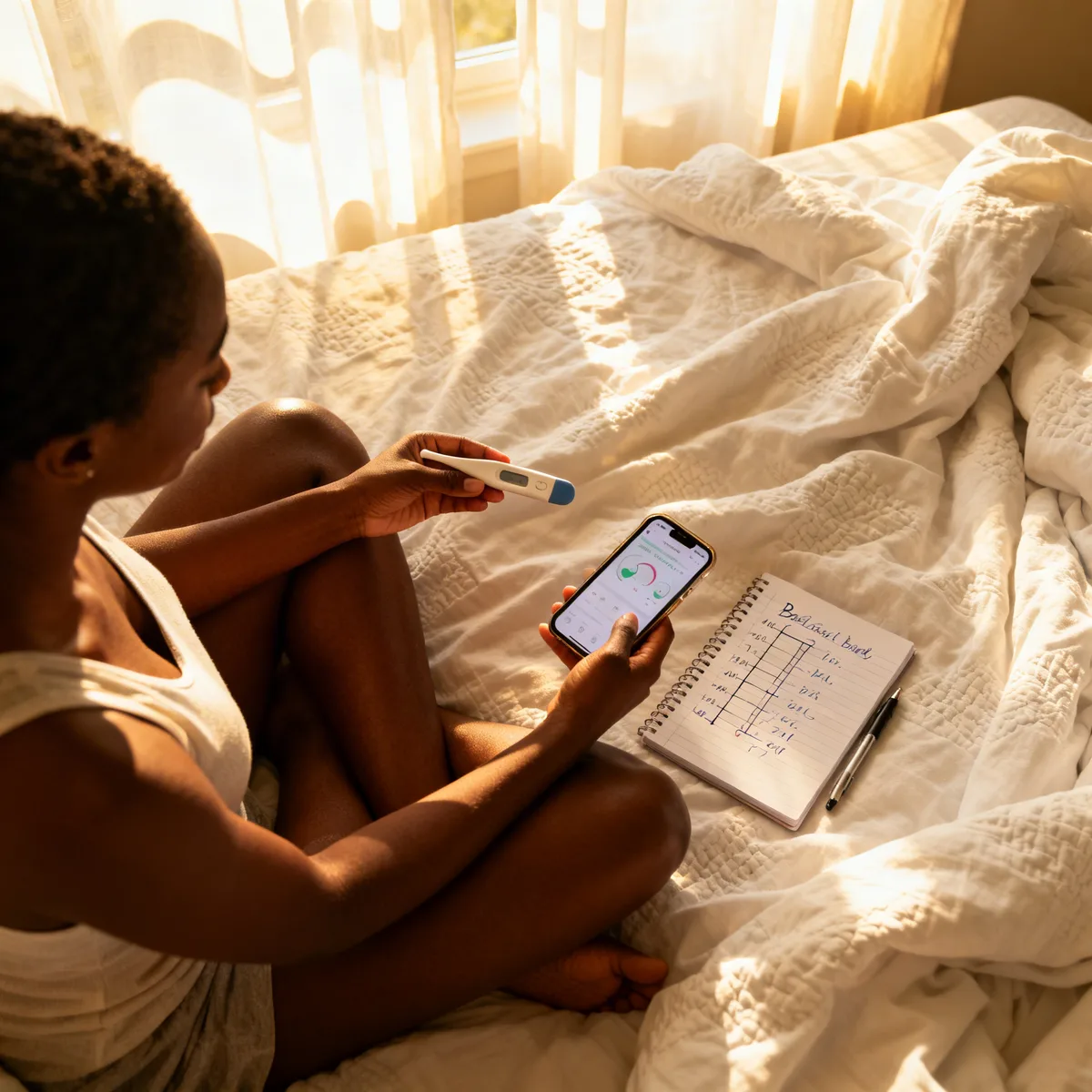
Basal body temperature is your resting temperature — the lowest your body reaches after at least three to four hours of uninterrupted sleep.
After ovulation, progesterone causes a measurable rise in BBT of approximately 0.2°C to 0.5°C (0.4°F to 1°F). That shift, once you can see it across several days, tells you ovulation has occurred.
To measure accurately, take your temperature at the same time every morning before you get out of bed, eat, drink, or speak. A standard thermometer won’t give you the precision you need — use a basal body thermometer, which reads to two decimal places.
Record each reading on a chart or in a tracking app. Over one to three cycles, a pattern emerges: a cluster of lower temperatures in the first half of your cycle, followed by a sustained higher cluster after ovulation.
The key word is sustained. A single elevated reading doesn’t confirm ovulation. You’re looking for a rise that holds for at least three consecutive days.
Here’s the realistic part: BBT tells you ovulation has already happened, not that it’s about to happen. The most fertile window — the two to three days before ovulation and the day of — will have passed by the time your temperature climbs.
This means BBT works best as a pattern tool over multiple cycles. Once you know your typical ovulation day, you can anticipate it in future cycles rather than chasing it after the fact.
Illness, alcohol, poor sleep, travel, or even taking your temperature at an inconsistent time can all skew readings. Note disruptions on your chart so you can interpret them accurately.
If you’re also noticing irregular spotting around mid-cycle, it’s worth reading about implantation bleeding versus period — the timing relative to your BBT chart can add useful context.
BBT is one of the most accessible ways to learn how to track ovulation. The data takes time to accumulate, but what it gives you is your own cycle — not a population average.
Your body produces cervical mucus throughout your cycle, and the texture changes in a predictable pattern tied directly to your hormone levels.
Right after your period, you may notice very little discharge — this is a relatively dry phase. As estrogen rises in the days that follow, mucus appears but tends to be thick, white, or creamy, with a consistency closer to lotion.

The shift worth paying attention to happens in the days approaching ovulation. Mucus becomes clearer, wetter, and increasingly stretchy — often described as resembling raw egg whites. This is your most fertile window.
The AAP recommends that women trying to conceive familiarise themselves with their own cycle patterns as a foundation for understanding reproductive health, noting that cervical mucus observation is a well-documented component of fertility awareness methods.
To observe, check before and after using the bathroom each day. Use clean fingers or tissue to collect a small amount, then gently press and pull your fingers apart to test the stretch.
Don’t aim for clinical precision. You’re looking for a trend — the shift from dry or creamy toward clear and slippery — not a single definitive reading.
Factors like antihistamines, hormonal conditions, or recent infections can temporarily alter mucus quality. Note anything unusual so you’re reading your pattern in context, not against an idealised textbook version.
Combined with BBT data, cervical mucus tracking gives you a fuller picture of how to track ovulation across your actual cycle. The two methods complement each other: temperature confirms ovulation has occurred, mucus signals that it’s approaching.
Once you’ve identified your fertile window with more confidence, your next step is understanding what happens after — which is when a visit with your provider becomes relevant. First ob appointment what to expect covers exactly that transition.
Your body releases a surge of luteinizing hormone (LH) 24 to 36 hours before ovulation. OPKs detect that surge in your urine, giving you a reliable heads-up before the egg is released — not just after.
Most kits work like a pregnancy test: two lines appear on a test strip. The key difference is how you read them. A positive OPK result means the test line is as dark as, or darker than, the control line — not simply visible.
Timing your testing matters. For a typical 28-day cycle, start testing around day 10 or 11. If your cycles run longer or shorter, the NHS recommends subtracting 17 from your average cycle length to find your start day.
Test once or twice daily, ideally in the afternoon between noon and 8 p.m. LH is produced in the morning but takes a few hours to appear in urine, so morning testing can cause you to miss the surge entirely.
Limit fluids for about two hours before testing. Diluted urine can weaken the LH concentration and produce a false-negative reading.
Once you see a positive result, the fertile window is open. The AAP notes that the days immediately surrounding ovulation represent the highest probability of conception for couples trying to conceive — making accurate detection of the LH surge clinically meaningful, not just convenient.
OPKs are particularly useful if BBT or cervical mucus tracking feels inconsistent or hard to interpret. They give you a direct hormonal signal rather than a secondary symptom to decode.
One limitation: OPKs confirm that an LH surge has occurred, but not that ovulation followed. Conditions like polycystic ovary syndrome (PCOS) can produce repeated LH surges without release of an egg. If you’re seeing multiple positives in one cycle, that’s worth raising with your provider.
Apps like Clue, Flo, Natural Cycles, and Ovia use algorithm-based predictions built from menstrual cycle data you log over time. Natural Cycles is the only app currently cleared by the FDA as a form of birth control — a meaningful regulatory distinction from the broader app category.
Wearables take a different approach. Devices like the Oura Ring and Tempdrop use continuous biometric monitoring — skin temperature, resting heart rate, heart rate variability — to detect physiological shifts that correlate with ovulation.
These tools can make it easier to understand how to track ovulation consistently, especially if manual methods feel hard to sustain across months. The data builds over cycles, and predictions typically sharpen as the algorithm learns your individual pattern.
Accuracy varies significantly. A 2020 study published in npj Digital Medicine found that algorithm-based apps correctly predicted ovulation windows around 21% of the time when benchmarked against urinary hormone data. Combining app tracking with a physical method — BBT or OPKs — tends to produce more reliable results than relying on any single signal.
Privacy is a real consideration. Fertility and cycle data is among the most sensitive health information you generate. Before choosing an app, review its data-sharing policy directly — specifically whether your data is sold to third parties or retained if you delete your account.
The AAP recommends that parents and caregivers evaluate all digital health tools critically, prioritising platforms with transparent data practices and, where possible, independent clinical validation.

One practical note: most apps work best when synced with at least one objective input. Logging symptoms alone gives the algorithm less to work with than pairing entries with BBT readings or LH test results.
The calendar rhythm method works by mapping your historical cycle data to predict when ovulation is likely to occur in future cycles. You track the length of your last 6–12 cycles, then apply a simple formula: subtract 18 days from your shortest cycle to find the start of your fertile window, and subtract 11 days from your longest to find the end.
This approach only functions reliably if your cycles are consistent — typically within a two-to-three day range month to month. Irregular cycles make the fertile window estimate too wide to be actionable.
Effectiveness rates reflect that limitation. The CDC places typical-use failure rates for calendar-based methods at around 12–24% per year, meaning it performs closer to the lower end of reliability compared to methods that track physiological signals directly.
That gap narrows when the calendar method is used as one layer among several. Pairing it with basal body temperature tracking, cervical mucus observation, or LH testing gives you a cross-reference point — the calendar tells you roughly when to look, and the other signals confirm what’s actually happening.
For anyone learning how to track ovulation for the first time, the calendar method is a useful orientation tool. It builds cycle literacy and pattern recognition before you layer in more precise inputs.
The AAP recommends that adolescents and adults using any fertility awareness method receive structured education on how the method works and its real-world limitations — not because the methods are inherently unreliable, but because correct application is what determines effectiveness.
One honest limitation: the calendar reflects your past, not your present. Stress, illness, travel, and postpartum hormonal shifts can all move ovulation outside your predicted window in any given cycle.
If your cycles have recently changed — including after birth or weaning — give your body at least three full cycles before relying on calendar-based predictions with any confidence.
No single method tells the whole story. The symptothermal method pairs basal body temperature tracking with cervical mucus observation — and sometimes adds LH testing as a third data point — to build a more complete picture of where you are in your cycle.
The logic is straightforward: BBT confirms that ovulation has already occurred, while cervical mucus and LH tests signal that it’s approaching. Used together, they cover both sides of the fertile window.
Research supports the combination. A 2007 study published in Human Reproduction found that the symptothermal method, when correctly applied, reached 99.6% effectiveness for avoiding pregnancy — comparable to hormonal contraception.
The most practical pairing for most people is cervical mucus monitoring plus BBT. Mucus changes give you advance notice; temperature shift gives you confirmation. If you want additional precision, adding an LH strip during the days of peak-quality mucus narrows the window further.
One caution: tracking three signals at once can create analysis paralysis, especially when readings seem to conflict. A slight BBT elevation doesn’t always mean ovulation; a positive LH test doesn’t guarantee it followed. This is normal variation, not failure.
The key is to look for patterns across several cycles, not certainty in a single day’s reading. If you’re learning how to track ovulation for the first time, start with two methods and add a third only once the first two feel intuitive.
Fertility awareness apps can help you visualise multiple data streams without manually cross-referencing them — but the data you enter is only as reliable as how consistently you collect it. The method works when you do.
The two to three days before ovulation and ovulation day itself offer the highest probability of conception. Sperm can survive up to five days in the reproductive tract, so intercourse five days before ovulation is still possible — but the closer to ovulation, the better your odds.
Yes, but it requires more observation and multiple methods. Irregular cycles mean ovulation timing shifts, so basal body temperature tracking, cervical mucus observation, and ovulation predictor kits become especially valuable because they detect your actual ovulation rather than predicting based on cycle length.
Combining two to three methods — often called the symptothermal approach — is more accurate than any single method alone. Most people find ovulation predictor kits (which detect the LH surge) combined with basal body temperature tracking or cervical mucus observation delivers the highest confidence.
PCOS and other hormonal conditions can make tracking more complex because they may cause irregular cycles or multiple LH surges. Basal body temperature and cervical mucus tracking are still observable, but ovulation predictor kits may be less reliable — consulting your provider about which methods suit your specific condition is important.
Start immediately if you’re planning to conceive soon — it typically takes one to three cycles to identify your pattern and feel confident reading your body’s signals. If you’re not actively trying yet, tracking for a few months gives you baseline data and helps you understand your unique cycle before you need it.