


Health Guides
Tongue Tie in Babies: Signs, Diagnosis, Treatment & Breastfeeding Recovery
Jeehoo Jeon·10 min read

Learn what causes cradle cap in newborns and how to safely treat it at home. Discover why it's not your fault and when to see a doctor.
If you’re searching for how to get rid of newborn dandruff, you’ll be relieved to know it’s not actually dandruff at all—and it has nothing to do with how often you wash your baby’s head. Cradle cap, or seborrheic dermatitis, is a temporary skin condition driven by leftover maternal hormones and a naturally occurring yeast, not poor hygiene or parental neglect. Most parents spend weeks worrying they’re doing something wrong, when the truth is this condition resolves on its own in 3 to 8 months. Once you understand what’s actually causing those flaky, yellowish scales—and what genuinely helps—you can stop stressing and start treating it effectively.
Cradle cap is the common name for infantile seborrheic dermatitis — a skin condition that causes flaky, scaly patches on a newborn’s scalp. The scales are often yellowish or white, and they can appear greasy or dry depending on your baby’s skin. To a lot of caregivers, it looks almost identical to adult dandruff, which is why “newborn dandruff” has become the everyday term for it.
The underlying cause is an overproduction of sebum — the skin’s natural oil — in the sebaceous glands. That excess oil causes dead skin cells to clump together rather than shed normally. The result is the visible scaling you see on the scalp. A naturally occurring yeast called Malassezia is also thought to play a role, feeding on the excess sebum and contributing to the buildup.
Two things cradle cap is not: contagious and caused by poor hygiene. It’s not passed between babies, and it’s not a sign that you’re bathing your newborn incorrectly or too infrequently. The AAP notes that cradle cap is extremely common in infants and typically resolves on its own within the first few months of life without requiring medical treatment.
The condition tends to peak in the first weeks after birth, when maternal hormones passed through the placenta are still influencing your baby’s skin and oil glands. Those hormones gradually clear, and so does the cradle cap in most cases.
If you’re already thinking about your newborn’s bath routine, the way you dry and care for their skin after washing matters more than most people realise — the how to dry newborn after bath guide covers what the AAP actually recommends for keeping delicate skin intact.
Cradle cap — formally called seborrhoeic dermatitis — is one of the most common skin conditions in newborns. It shows up as greasy, yellowish scales or flaky patches on the scalp, and occasionally on the eyebrows, ears, or nose. Understanding what’s driving it helps explain why it’s so widespread and, usually, so temporary.
Three main factors are at work. The first is hormonal. During pregnancy, maternal hormones cross the placenta and stimulate your baby’s sebaceous glands — the oil-producing glands in the skin. After birth, those hormone levels don’t drop immediately. The result is overactive oil glands that produce more sebum than the scalp can shed efficiently, leading to a buildup of dead skin cells.
The second factor is a yeast called Malassezia. This yeast lives naturally on human skin, but in sebum-rich environments it can proliferate more rapidly. Research has linked Malassezia overgrowth to seborrhoeic dermatitis across all age groups. In newborns, the combination of excess sebum and an immature skin microbiome creates exactly the conditions where this yeast thrives.
The third piece is the skin barrier itself. A newborn’s skin barrier is still developing in the weeks after birth. It’s thinner, more permeable, and less efficient at regulating moisture and shedding dead cells at a normal rate. The AAP notes that newborn skin undergoes significant structural changes in the first month of life as it adapts from the amniotic environment to the outside world — and this transition period is precisely when cradle cap tends to appear.
None of these factors involve poor hygiene. Cradle cap is not caused by inadequate washing, and it isn’t contagious. For many families trying to understand newborn week 1 changes, cradle cap is simply part of the skin’s adjustment process — one that typically resolves on its own within a few months.
Most cases respond well to a simple, consistent routine. The AAP recommends starting with the gentlest approach and stepping up only if needed.
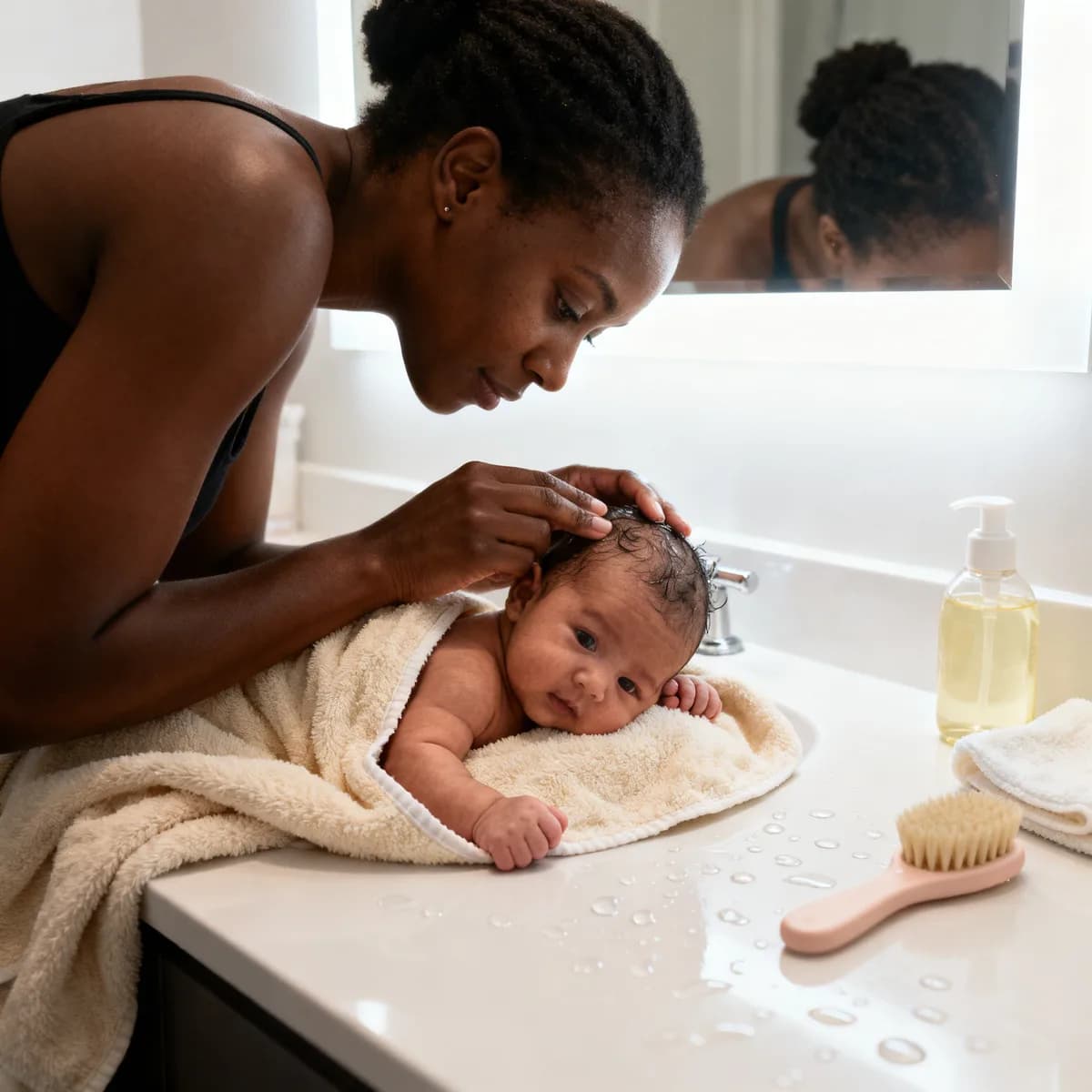
Step 1 — Loosen the scales with oil. Apply a small amount of natural oil — mineral oil, coconut oil, or baby oil — to the affected area. Let it sit for 15 to 20 minutes to soften the flakes. Do not leave oil on overnight; prolonged contact can worsen buildup.
Step 2 — Brush gently. Use a soft-bristled baby brush or a fine-toothed comb to lift the loosened scales. Work slowly and avoid any scraping motion. The goal is to ease flakes away, not force them off.
Step 3 — Wash with a gentle shampoo. Rinse away the oil using a mild, fragrance-free baby shampoo. Lather lightly, then rinse thoroughly. The CDC notes that newborn skin absorbs more through its surface than adult skin does, so formula matters — look for products formulated without sulfates or synthetic fragrance. If you want a shampoo designed specifically with newborn skin in mind, Cha&Mom is what I reach for — it’s the kind of thing a friend with a Korean skincare background would quietly recommend. You can read more about why formulation philosophy differs across brands in this breakdown of CeraVe Baby vs Mustela for baby.

Step 4 — Repeat consistently. Once or twice a week is typically enough. Daily washing is not necessary and can strip the scalp’s natural moisture barrier.
On over-the-counter options: The AAP advises against using medicated shampoos — including those containing selenium sulfide or ketoconazole — on infants without a pediatrician’s guidance. These are formulated for older skin. If the standard routine isn’t improving things after a few weeks, that’s the right time to call your provider.
The ingredient list on a baby shampoo matters more than the packaging suggests. For a scalp dealing with flaking and buildup, the wrong formula can quietly make things worse — even one labelled “gentle” or “natural.”
Look for cleansers with a short, recognisable ingredient list. Gentle surfactants like decyl glucoside and coco-glucoside clean effectively without disrupting the scalp’s lipid barrier. For moisture, colloidal oatmeal, panthenol (vitamin B5), and ceramides help restore and maintain the skin barrier without clogging follicles. These are well-tolerated by newborn skin and have a solid safety record.
The AAP recommends using only plain, fragrance-free products on newborn skin — fragrance (whether synthetic or “natural”) is one of the most common contact irritants in infant skincare and can trigger inflammation that worsens scalp buildup rather than resolving it.
Harsh sulfates — sodium lauryl sulfate in particular — strip the scalp’s natural oils aggressively. That sounds like it might help with grease-related flaking, but it often triggers a rebound effect: the scalp produces more oil to compensate, extending the cycle you’re trying to break. If you’re looking at how to get rid of newborn dandruff through product choice alone, avoiding these two ingredients is the most practical place to start.
If you want a starting point for a cleaner routine, Cha&Mom is a Korean baby skincare line that’s been getting quiet word-of-mouth among mums who’ve already run through the usual drugstore options — worth looking at if you’re rebuilding your wash routine from scratch.
For a deeper look at how bamboo baby towels fit into a gentler post-bath routine, that piece covers the fabric side of things with the same ingredient-level detail.
Most cradle cap resolves on its own within a few months. Gentle washing, a little oil, and patience covers the majority of cases. But there are specific signs that mean it’s time to call your pediatrician — not tomorrow, soon.
Watch for these:
It’s spreading beyond the scalp. Cradle cap stays on the head. If you notice similar scaly or crusty patches moving to the face, neck folds, armpits, or diaper area, that pattern points toward seborrheic dermatitis or eczema — both of which benefit from a clinical assessment rather than home management alone.
The skin underneath looks angry. Some redness under flakes is normal. Intense redness, swelling, or skin that feels warm to the touch is not. These are signs of inflammation that may need treatment.
There’s oozing, weeping, or crusting with a yellow tint. This can indicate a secondary bacterial infection. Broken skin on a newborn’s scalp is an entry point for bacteria. If you see discharge or the area smells different, contact your pediatrician the same day.
Your baby seems uncomfortable. Standard cradle cap doesn’t itch or hurt. If your baby is scratching at their head, seems irritable around the area, or is losing hair in patches, that’s worth flagging.

The AAP recommends that any skin condition in a newborn that spreads, becomes infected, or doesn’t improve with basic care be evaluated by a pediatrician — particularly in the first three months of life, when immune responses are still developing.
If you’ve been working through how to get rid of newborn dandruff at home and nothing is shifting after several weeks of consistent care, that’s also a reasonable reason to get a second opinion. A pediatrician can rule out fungal involvement, which sometimes requires a medicated shampoo rather than home remedies. Understanding korean baby skincare ingredient standards can also help you identify whether what you’re currently using might be contributing to the problem.
For most babies, cradle cap appears in the first few weeks of life and clears up on its own between three and eight months of age. Some cases resolve faster — by the two-month mark. Others linger closer to the first birthday. Both ends of that range are considered normal.
The AAP notes that seborrheic dermatitis in infants — the clinical name for cradle cap — is a self-limiting condition, meaning the body resolves it without medical treatment in the vast majority of cases.
What drives that timeline? The same maternal hormones that trigger cradle cap gradually leave your baby’s system over the first several months of life. As hormone levels normalize, sebaceous gland activity slows, and the scalp naturally regulates itself. There is no intervention that meaningfully accelerates this process — consistent, gentle care helps manage the appearance, but it doesn’t change the underlying biology.
If you’re trying to figure out how to get rid of newborn dandruff, the honest answer is that patience is part of the protocol. Softening flakes with a light oil, brushing gently with a soft cradle cap brush, and washing regularly with a mild shampoo keeps the scalp comfortable and the buildup manageable. It won’t make the condition disappear ahead of schedule, but it does reduce discomfort and visible flaking in the meantime.
A small number of babies experience cradle cap that extends past twelve months or spreads beyond the scalp — to the eyebrows, ears, or neck folds. That pattern is worth flagging with your pediatrician, not because it signals something serious, but because persistent or widespread seborrheic dermatitis sometimes responds better to targeted treatment than to home care alone.
For most families, though, this resolves quietly on its own. Consistent care, realistic expectations, and time are the actual formula.
No on both counts. Cradle cap is not contagious and is not caused by poor hygiene or infrequent washing. It’s driven by maternal hormones and a naturally occurring yeast called Malassezia, both of which are completely normal. You did not cause it, and washing your baby’s head more frequently won’t prevent or cure it.
Regular gentle baby shampoo can help, but look for formulations without harsh sulfates or fragrance, which can irritate the scalp further. Mild cleansers and moisturizers designed for sensitive or flaky skin work better. Many pediatricians recommend products specifically formulated for cradle cap or seborrheic dermatitis in infants.
Washing 2 to 3 times per week with a gentle cleanser is typically recommended. More frequent washing can dry the scalp and make scaling worse, while less frequent washing allows buildup to continue. Follow your pediatrician’s specific guidance for your baby’s skin.
No. Cradle cap does not cause permanent scarring or lasting hair loss. It is a temporary, surface-level skin condition that resolves completely on its own within a few months. Any hair shedding that occurs is temporary and regrowth happens naturally.
Oils can help soften scales and make them easier to brush away gently, but they can also trap moisture and potentially worsen the condition if overused. If you use oil, apply it sparingly, massage gently, and wash it out thoroughly within a few hours. Always check with your pediatrician before applying any oil to your baby’s skin, especially if the cradle cap is severe or spreading.