


Buying Guides
Bamboo Baby Products Benefits: Why Smart Parents Are Making the Switch to Bamboo Towels
Soyeon Park·10 min read

Find the best portable high chair for restaurants, air travel, and family visits. Compare clip-on, hook-on, and booster seat options with safety tips and packing strategies.
POV: You’re at a restaurant with your toddler, the server brings a wobbly booster seat that smells like someone else’s breakfast, and you’re already regretting not bringing your own chair.
The truth is, a good portable high chair solves this problem completely — but only if you pick the right type for how you actually travel and eat.
This guide walks you through the three main categories of portable high chairs, the features that actually matter, and honest recommendations for restaurants, family visits, and air travel so you can feed your kid anywhere without the chaos.
Not all portable high chairs solve the same problem. Before you buy, figure out where you’re actually feeding your kid — because the answer changes everything.
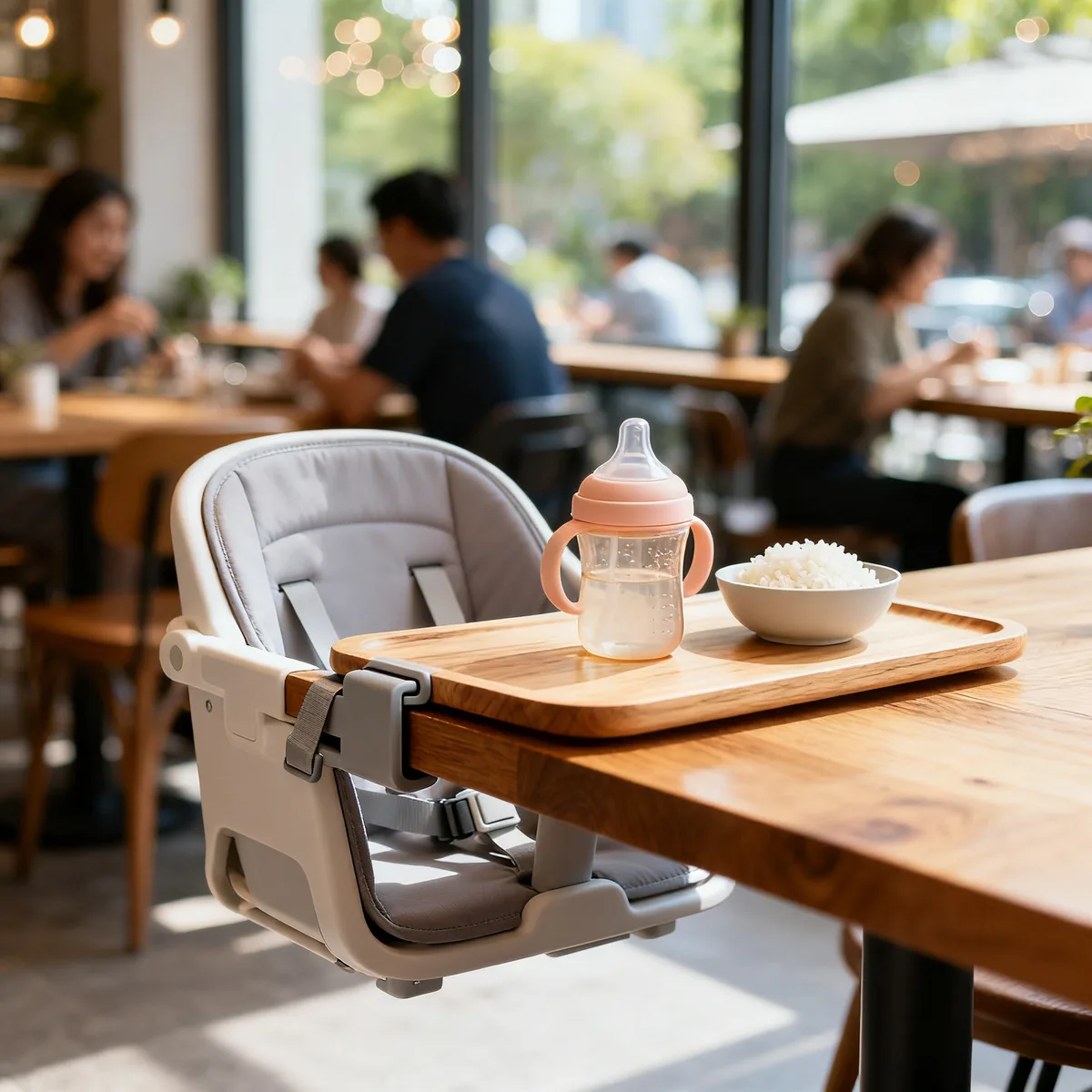
Clip-on chairs attach directly to the table edge. They’re compact, lightweight, and ideal if you eat out a lot or travel frequently. The catch: they need a solid, non-glass table to clamp onto, so they don’t work everywhere.
Travel booster seats strap onto a standard dining chair. They’re the most versatile option — they work at restaurants, grandma’s house, vacation rentals, wherever there’s a chair. If you’re looking for the best portable high chair for travel across different environments, this is usually the safest bet.
Hook-on chairs are essentially clip-ons with a more refined design — they hook under the table rather than clamping the edge. Slightly more secure on certain surfaces, and often sleeker. Still table-dependent, same limitations apply.
The honest breakdown: if you’re a restaurant family, clip-on or hook-on. If you’re constantly moving between locations with different setups, a travel booster gives you more flexibility. If you’re feeding a younger baby who needs more back support, check weight and age minimums carefully — not all portable options are built for early sitters.
It’s also worth knowing how a portable chair fits into your longer-term feeding setup. If you haven’t landed on a full-size chair yet, the high chair buying guide breaks down what actually matters when you’re making that call.
One more thing: don’t assume portable means less safe. It means less bulky. Safety comes down to the specific chair, how you use it, and whether your kid actually fits it properly.
Weight limit is the first number to check. Most portable chairs cap somewhere between 33 and 50 pounds — that range matters more than you’d think if you’re buying for a toddler who’s already on the heavier side.
Pack size is what separates a chair you’ll actually bring from one that stays in the garage. Look at packed dimensions against your bag, not just folded weight. A chair that’s light but bulky loses the point.
Setup time should be under two minutes, realistically under one. If it takes longer than that in a quiet room, it’ll take four times as long at a crowded restaurant with a hungry kid in your arms.
Table compatibility is where a lot of people get caught off guard. Clamp-on styles have thickness limits — most work up to around 2.5 inches, but thick-edged tables, tables with lips, or pedestal bases can all be deal-breakers. Check the specs before you pack it.
For safety certifications, look for ASTM F1235 (the US standard for portable hook-on chairs) or EN 16120 if you’re traveling internationally. These aren’t optional boxes to check — they’re the baseline.
Harness design matters too. A five-point harness is the standard worth holding out for, especially if you’re using the chair at varying heights or on less stable surfaces.
Cleaning is the spec nobody talks about until they’re wiping pureed sweet potato out of a mesh seat at 10pm. Removable, dishwasher-safe seat pads make a real difference. Avoid chairs with deep fabric folds or hardware that traps food.
When you’re hunting for the best portable high chair travel option, these specs are what separate a chair that earns its bag space from one that becomes a gift for your sister-in-law. Build quality shows up in the details — not the product photos.
The Inglesina Fast Table Chair is the go-to for restaurant use. It clamps directly onto the table edge, keeps your baby at adult height, and folds flat into a compact bag. Weight limit is 37 lbs — works from roughly 6 months through toddlerhood, as long as your kid can sit independently.
Setup takes about 20 seconds once you’ve done it twice. The catch: it needs a table edge at least 1.5 inches thick and no wider than 2.5 inches. Glass tables and very thick slabs are a no. Always check before you sit down.
The Phil&teds Lobster is the other serious contender. Also a clip-on, similar age range (6 months to 33 lbs), slightly bulkier but with a more padded seat. Easier to wipe down. Harder to pack into a small bag.
For family visits where you need a floor-standing option, the Hiccapop OmniBoost converts from a booster to a standalone chair. It’s heavier than clip-ons — about 5 lbs — but sits on any flat surface without requiring a compatible table. Supports up to 50 lbs, which gives you real longevity.

The honest tradeoff: clip-ons win on packability, boosters win on versatility. If you’re mostly doing restaurants, go clip-on. If grandma’s house has round tables or you’re navigating unpredictable surfaces, the booster makes more sense.
One real-world note — restaurant floors are rarely clean, and bags that sit on them come home with everything. A chair that attaches to the table or a bag with a wipeable base is worth the slight upcharge.
If feeding logistics are already stretching you thin, the setup piece matters more than you’d think. The same way you’d research a formula feeding guide newborn parents rely on — the details are where the real decisions live.
Flying with a baby who needs to eat is its own category of logistics. The seat-back tray is too big, the gate area has nowhere to prop a baby, and restaurant stops along the way are wildly unpredictable.
The best portable high chair travel setups for flying tend to be soft-structured booster seats that compress into a flat pack — think under two pounds and small enough to fit inside a carry-on without sacrificing your own overhead bin space.
Look for options with a three-point or five-point harness. Compact doesn’t mean the safety standards change.
Hook-on chairs are worth considering here too. Most fold nearly flat, weigh around two pounds, and clip directly to airport restaurant tables or any solid surface with a lip — no legs on a filthy terminal floor.
For checked baggage, you have more flexibility, but weight still matters when you’re hauling everything else. A chair that compresses into its own carry bag and comes in under four pounds keeps the cumulative load from becoming a problem by day two.
One thing that gets overlooked: material. Travel means crumbs in weird places, spills on planes, and wipe-downs in gas station bathrooms. Mesh or coated fabric cleans faster than textured foam and dries before the next feeding.
If you’re also managing a pumping schedule working mom travel logistics, the less floor space and setup time a chair requires, the better your whole system runs.
Skip anything that requires a dedicated assembly step or comes with parts that can be lost mid-trip. The goal is a chair you can deploy one-handed while the other hand is doing something else — because that’s always what’s happening.
The wobble question comes up constantly. A clip-on chair is only as stable as the table it’s attached to — thin, glass, or pedestal tables are real problem surfaces, and most manufacturers will tell you that plainly in the specs if you read them.
Check the minimum table thickness requirement before you travel. Most clip-on designs need at least 1.5 inches of solid edge to grip properly. Below that, the chair moves. That’s not a maybe.
Weight capacity is worth tracking over time, not just at purchase. A chair rated for 35 pounds handles a 14-month-old fine. It handles a 2.5-year-old less confidently. If your kid is growing fast and you’re still relying on the same seat, recheck the specs — don’t assume.
For harness-style and fabric booster seats, the straps are the hygiene weak point. Food gets into the buckle mechanism and the webbing, and it stays there. Look for straps that detach completely or lie flat enough to hand-wash without special equipment.
Seat fabric matters here too. Textured or quilted padding traps puréed anything. Smooth, coated surfaces wipe down in 30 seconds. That difference is significant when you’re cleaning up after a meal in a restaurant bathroom with paper towels.
Repeated setup and teardown is harder on gear than people expect. The hinges, clamps, and fold points on budget options tend to loosen after 50 or 60 uses — which sounds like a lot until you’re traveling every other month.
If finding the best portable high chair travel option matters to you, durability under real use is a bigger factor than the purchase price. A chair that wobbles or buckles after six months of use isn’t a bargain.
The chair goes in last. That sounds obvious until you’ve repacked your bag three times at the airport because the straps got tangled around the diaper changing pad.
Most clip-on and soft hook-on chairs fold flat or roll into a compact pouch. Keep that pouch clipped to the outside of your backpack if your main compartment is already running tight — fighting for interior space with a change of clothes and a snack stash is a losing game.
Dedicate one consistent spot for it every single time. Muscle memory is the only reason packing with a baby stays sane.
For eating out, bring two things: a small pack of unscented wet wipes and a thin muslin cloth. The wipes handle the seat surface before you buckle your kid in. The muslin goes down on the restaurant table as a barrier if your chair clips directly onto it.

Post-meal cleanup is faster than you think if you’re not trying to be thorough. Quick wipe of the seat, fold it up, handle the real clean at the hotel or home. Scrubbing marinara out of a harness strap in a restaurant bathroom with hand soap isn’t a strategy — it’s a punishment.
If your chair has a removable seat pad, take it off before you pack it back up. Trapped crumbs and moisture are what cause that smell. You know the one.
One thing worth knowing: if you’re already thinking through your full travel setup — stroller, carrier, high chair — getting the best stroller for newborn research right early means you’re not doubling up on bulk later. The gear decisions compound.
They’re not the same thing, and using the wrong one for the wrong situation is how you end up holding a baby with one arm while eating with the other.
A restaurant booster seat is a hard plastic block that raises your child to table height. It works fine for a toddler who can already sit independently and doesn’t need containment — but it offers zero support for younger babies, and it’s usually strapped to whatever chair the restaurant gives you.
A portable high chair — the kind designed for travel — is a different category. It’s built to attach to most standard chairs, has a harness, and gives a younger baby actual structure. That’s the gap worth understanding.
For coverage: portable high chairs generally fit babies from around 6 months (when they can sit with support) up to toddler age. Restaurant boosters are really a toddler-and-up solution. If you’re still in the early sitting stage, a booster won’t cut it.
For portability: a fabric hook-on high chair folds flat and fits in a tote bag. A restaurant booster is bulky plastic. One of these goes with you on a weekend trip. The other stays in the car at best.
For cleanup: both get dirty fast. The advantage with a good fabric travel chair is a seat that wipes down or removes entirely. Hard plastic boosters trap food in every seam — and restaurant ones have been cleaned by no one, ever.
When does each make sense? Booster seats work for older toddlers at family dinners where you’re not hauling gear. If you’re researching the best portable high chair travel options for a baby under one, or a trip with multiple restaurant stops, a proper hook-on chair is the smarter call.
It’s also worth thinking about the full activity picture — water play baby activities and outdoor meals are exactly when portable seating earns its bag space.
Clip-on chairs clamp directly onto the table edge, while hook-on chairs slide under the table for a more refined grip. Both are safe when used correctly on appropriate surfaces, but hook-on styles often feel more secure on certain tables.
The key difference is stability: hook-on chairs distribute weight differently and may wobble less on thin tables. Always check weight limits and table compatibility for your specific model.
Most clip-on and hook-on chairs work best on solid, non-glass tables with a thickness of 0.75 to 2.5 inches. Thick-edged tables, pedestal bases, and tables with built-in lips can be deal-breakers depending on the clamp design.
Always check the manufacturer’s specs before assuming your favorite restaurant table will work — or test it with your own table at home first.
Most quality portable high chairs weigh between 2 to 5 pounds, with the lightest models topping out around 2 pounds. A lightweight clip-on or hook-on chair easily fits in a large diaper bag or backpack alongside other essentials.
Travel booster seats are bulkier but still packable. The real test: compare packed dimensions to your actual bag before buying, not just the weight.
Many fabric and mesh portable chairs have removable, machine-washable seat covers — check the label before assuming. Plastic or vinyl models usually just need a wipe-down with a damp cloth.
For quick restaurant cleanups, bring antibacterial wipes in your diaper bag. Rinse fabric straps and seat covers when you get home, then air-dry completely to prevent mold.
Most portable high chairs are designed for babies 6 months and older, with weight limits ranging from 33 to 50 pounds depending on the model. Your toddler will outgrow the seat when they exceed the manufacturer’s weight limit or can climb out safely.
Once they’re over the limit or regularly escaping, a standard booster seat or cushioned restaurant chair becomes the safer option. Check your specific chair’s specs — they vary widely.