

Buying Guides
Best Portable High Chair for Travel: Reviews & Buying Guide for On-the-Go Feeding
Soyeon Park·11 min read

Discover the best Korean baby snacks for toddlers — transparent ingredients, no artificial additives, and flavors kids actually love. Parent-approved guide inside.
Korean baby snacks have earned their reputation not through marketing, but through a genuinely different approach to toddler nutrition. Short ingredient lists, transparent sourcing, and flavors that don’t train your kid’s palate toward sugar are the norm, not the premium option. This guide walks you through the best Korean baby snacks, how to read the labels, and why parents are making the switch.
Korean food culture has always treated eating as something worth taking seriously — not in a precious way, but in a practical one. You feed kids real ingredients because that’s just what you do. That philosophy carries directly into how Korean baby snacks are made.
The ingredient lists are short. Not “marketing short” — actually short. Rice, seaweed, sweet potato. Things you’d find in a kitchen, not a chemistry lab. Artificial colors, synthetic preservatives, added sugars — they’re largely absent not because a brand made a trend-chasing decision, but because they weren’t part of the approach to begin with.
There’s also something to be said about flavor. Korean snacks for kids tend to be lightly savory or subtly sweet — umami-forward rather than sugar-forward. That matters more than it sounds. When toddlers get used to intense sweetness early, mild whole foods start losing the competition. These snacks don’t train that reflex.
Seaweed is a good example. It’s mineral-rich, low in calories, and has a distinct flavor that doesn’t need anything added to it. Korean kids grow up eating it as a completely normal snack. The fact that Western parents are now discovering it isn’t a trend — it’s just catching up.
What resonates with parents right now isn’t just clean ingredients. It’s transparency. You can read the label and actually understand it. You know what you’re handing your kid. That kind of clarity is harder to find than it should be, and it’s one of the main reasons Korean baby snacks have moved from specialty import shelves to something parents actively seek out.
Less noise on the label usually means less noise in the product. That’s the whole idea.
Not all snacks are worth the shelf space. Here’s what actually holds up — by category, by age, by what’s inside.
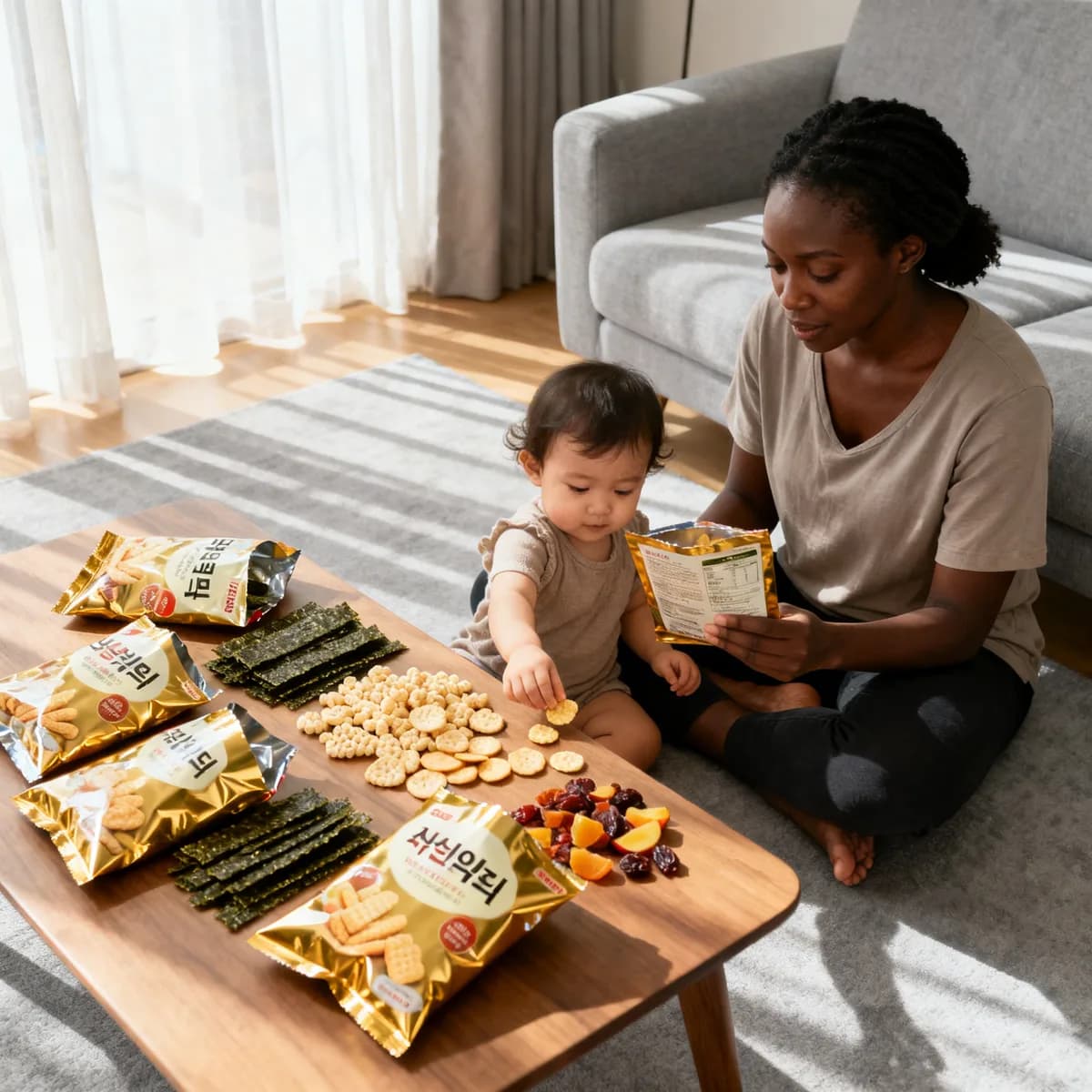
Rice puffs. The classic starting point. Light, dissolvable, and low-allergen. Most are made with non-GMO rice and minimal salt. Good from around 6 months when solids are just beginning. Look for ones with no added sugar and a short ingredient list — ideally five items or fewer.
Seaweed snacks. Roasted, lightly salted, and genuinely nutritious. Seaweed is naturally high in iodine and minerals most toddler diets are short on. Thin sheets dissolve quickly, which makes them manageable for kids 10 months and up. The flavor skews savory, which actually helps — you’re not training a sweet preference every snack time.
Freeze-dried fruit. Real fruit, most of the water removed, nothing added. Strawberry, mango, banana — the texture is airy and easy to chew. Around 9 to 12 months is a reasonable window depending on how comfortable your kid is with solids. Check that the only ingredient listed is the fruit itself. That’s the whole standard.
Yogurt drops. Freeze-dried yogurt in small, melt-on-contact pieces. High in probiotics, easy to pick up for developing pincer grip, and usually made with whole milk yogurt and real fruit. Fine from around 10 months. Worth checking that there’s no added sweetener — some brands sneak it in.
Naeiae covers most of these categories reliably — the ingredients are straightforward, the age guidance on packaging is actually useful, and the formulations stay consistent across their range. Their snacks are available at Onzenna.
Korean snack culture has always leaned toward functional ingredients — things that do something, not just fill space. That carries over into how toddler snacks are made, and it’s one of the reasons korean baby snacks have built a quiet reputation among parents who read labels closely.
sweet potato snacks Rice is another staple — puffed, baked, or ground into flour — because it’s easy to digest and low on the allergen scale. Good for introducing texture without overwhelming a gut that’s still figuring things out.
Seaweed is worth paying attention to. In Korean cooking it’s not a novelty — it’s a daily food. For toddlers, it’s a low-calorie source of iodine, which matters for thyroid function and brain development. Look for versions that are lightly seasoned or unseasoned, and check sodium levels if your toddler is eating it regularly.

Probiotics are increasingly common in Korean toddler snacks, added to yogurt puffs and grain bites. The reasoning is straightforward: gut health in early childhood has downstream effects on immunity, digestion, and even mood. Not all probiotic strains are created equal, but their presence usually signals a brand thinking beyond the basic nutrition label.
What ties these ingredients together is restraint. The best options in this category keep the list short — whole grains, real produce, minimal processing. When you’re scanning packaging, ingredients like glutinous rice, purple sweet potato, and lacto-fermented cultures are signals you’re in decent territory. A long list of emulsifiers and natural flavors is a signal to keep moving.
Korean packaging can feel like a puzzle if you don’t read Hangul. But here’s the thing — the structure of Korean nutrition labels is actually more standardized than what you’ll find on a lot of Western products. Once you know what you’re looking at, it’s easier to cut through the noise.
Start with the ingredient list. In Korea, ingredients are listed in descending order by weight, same as in the US. So if brown rice or sweet potato is first, that’s genuinely what you’re getting most of. If sugar or syrup shows up in the top three, that’s your answer.
Sodium is worth watching closely. Korean food culture skews savory, and even snacks marketed as mild can carry more salt than you’d expect for small eaters. Check the per-serving number against your child’s daily limit — most pediatric guidelines recommend under 1,000mg daily for toddlers, well under 400mg for infants.
Look for the age designation on the front. Reputable Korean baby snacks brands label clearly — 6개월 (6 months), 12개월 (12 months). That’s not just marketing segmentation; it usually reflects actual formulation differences in texture, sodium content, and allergen inclusion.
The phrases to be skeptical of: “natural flavor” (천연향) added to something that should taste like itself, and vague terms like “nutritionally enhanced” without specifics. Real transparency looks like a short ingredient list with recognizable whole foods and a nutritional panel that doesn’t require a calculator to parse.
One practical shortcut: brands that submit to third-party certification — look for HACCP or organic certification logos on packaging — have cleared an external bar. That doesn’t make a product perfect, but it means someone outside the company checked the work. That matters.
Put a popular Western toddler puff next to a Korean rice cracker and the ingredient lists tell very different stories. The Western version often leads with enriched flour, followed by a short parade of sugars under different names — maltodextrin, dextrose, fruit juice concentrate. The Korean version typically starts and ends with rice. Sometimes seaweed. Maybe a single seasoning. That’s it.
Sugar content is where the gap gets hard to ignore. A single-serve pouch of a mainstream Western fruit snack can carry 11–14 grams of sugar. A comparable Korean baby snack — rice puffs, roasted seaweed chips, barley crackers — usually comes in under 3 grams, often with zero added sugar. For toddlers whose palates are still forming, that difference compounds over time.
Texture and developmental fit is another dimension most comparisons skip. Korean snacks designed for babies tend to dissolve predictably and come in sizes calibrated for small hands and early chewing. Western options vary wildly — some dissolve well, others are dense enough to require real molars. Worth checking, not assuming.
The flavor philosophy is also different. Western toddler snacks often skew sweet even when they’re marketed as savory. Korean options lean on umami — seaweed, rice, mild fermented notes — which introduces a broader flavor vocabulary early. That’s not a cultural preference point; there’s actual developmental reasoning behind exposing kids to a range of tastes before preferences calcify around age two.
None of this means every Western snack is a problem or every Korean option is automatically superior. It means reading labels with the same critical eye either way. The baseline question stays the same: short ingredient list, low added sugar, texture that matches where your kid actually is developmentally. Geography of origin matters less than what’s inside the bag.
Start with texture, not flavor. If your toddler is still navigating soft foods, a crunchy seaweed sheet might be a harder sell than a rice puff that dissolves fast. Match the format to where they actually are, not where you want them to be.
Pair something new with something familiar. Put a new snack next to a food they already trust. Not to hide it — just to lower the stakes. When a toddler isn’t defending territory, they’re more likely to explore. Give them the option without the speech about how good it is for them. The sell kills curiosity every time.

Expect rejection. Then ignore it. Research on food neophobia is pretty consistent: kids often need eight to fifteen exposures before accepting a new food. One “no” at the table doesn’t mean no forever. Keep offering without pressure. Make it boring. Boring works.
Korean baby snacks tend to work well in this process because many are built around simple, single-note flavors — plain rice, mild seaweed, lightly sweet grain puffs. There’s not a lot competing for attention in the ingredient list, which makes them easier entry points than heavily processed options with ten flavors hitting at once.
Watch for sodium. Seaweed snacks, even toddler-targeted versions, can vary a lot in salt content. Check the label the same way you would anything else. Low-sodium versions exist and are worth seeking out for daily snacking.
Build a rotation instead of a routine. Rotating through a few different snacks — textures, flavors, formats — is more useful long-term than landing on one thing that works and never moving. Variety early makes variety normal. That’s the whole point of this window.
Most Korean snacks come sealed in individual portions, which makes storage straightforward — but there are a few things worth knowing before you start stocking up.
Expiration dates on Korean packaging follow a year-month-day format. So 26/04/15 means April 15, 2026, not the 26th of anything. If you’re ordering imported snacks online, check the date before the package goes into the pantry. It’s easy to miss when you’re moving fast.
Seaweed snacks lose their crunch fast once opened. If your toddler doesn’t finish a pack, don’t save the rest — the texture changes within hours and they’ll likely reject it anyway. Individual portion packs sidestep this problem entirely. Same rule applies to rice puffs and grain crackers: once the seal is broken, eat it or toss it.
For anything with a longer ingredient list — snacks that include fruit, dairy, or soy — store unopened packages away from heat and humidity. A pantry shelf is fine. A bag left in a warm car is not. Korean packaging often uses thinner film than what you might see on domestic brands, so it’s worth being a little more deliberate about where you’re keeping things.
If you’re buying korean baby snacks through an import retailer or marketplace, pay attention to shipping conditions. Snacks that traveled in summer heat or sat in a warehouse too long can degrade before the expiration date technically hits. Buying from a retailer with real inventory turnover matters more than it might seem.
Allergen labeling on Korean packaging follows Korean regulatory standards, which differ from U.S. requirements. If your child has any known allergies, cross-reference with an English translation or reach out to the brand directly. Don’t guess.
Most Korean baby snacks have transparent, minimal ingredient lists, which makes identifying allergens easier. However, always check packaging carefully — cross-contamination can occur during manufacturing. Common allergens like tree nuts, sesame, and soy appear in some products. When in doubt, contact the manufacturer directly or start with single-ingredient snacks like plain rice puffs or freeze-dried fruit.
It depends on the snack type. Rice puffs are safe from around 6 months when solids begin. Freeze-dried fruit works well from 9 to 12 months. Seaweed snacks are best introduced around 10 months and up, once your toddler can handle more complex textures. Always follow your pediatrician’s guidance on readiness for solids and new foods.
Read the actual ingredient list, not the front-of-package claims. Genuinely healthy snacks have five items or fewer, recognize every ingredient, and contain no added sugars, artificial colors, or synthetic preservatives. Check the nutrition label for sugar content — Korean snacks tend to be naturally lower, but some yogurt drops or fruit snacks can surprise you. When in doubt, compare labels side by side.
Specialty Korean grocery stores, both in-person and online retailers like Amazon, YesStyle, and Yesstyle carry authentic brands. Many mainstream grocery chains now stock Korean baby snacks in their international or baby sections. Look for established Korean brands with clear English labeling and verify the seller’s reputation to avoid counterfeit products.
Most reputable Korean baby snacks are formulated without added sugars or artificial colors and preservatives — that’s part of their foundational philosophy. However, not all Korean snacks are created equal. Some yogurt drops or fruit blends may contain added sugars, so always check the nutrition facts panel and ingredient list. The fewer items listed, the more likely you’re getting a genuinely clean product.