


Health Guides
Tongue Tie in Babies: Signs, Diagnosis, Treatment & Breastfeeding Recovery
Jeehoo Jeon·10 min read
Baby fever guide: temperature thresholds by age, red flags for urgent care, and when home monitoring is safe. Get AAP-backed guidance for newborns to older infants.
Here’s what catches most parents off guard: a baby fever isn’t always the enemy. In fact, fever is your baby’s immune system doing exactly what it’s supposed to do — fighting off infection and building defenses.
The tricky part isn’t the fever itself. It’s knowing which numbers matter, which symptoms demand a 2 a.m. call to your pediatrician, and which ones you can safely handle at home while your baby recovers.
Baby First Step Kit
Not every elevated reading means something is wrong. What qualifies as a fever depends on your baby’s age and how you took the measurement.
The AAP defines a fever in infants as a rectal temperature of 100.4°F (38°C) or higher. Rectal measurement is considered the most accurate method for babies under three months — other methods introduce enough variability that they can miss a true fever at this age.
Here’s how the numbers break down by method:
Rectal: 100.4°F (38°C) or above is a fever at any age.
Axillary (underarm): 99°F (37.2°C) or above — less reliable, typically used as a screening tool only.
Temporal artery (forehead): 100.4°F (38°C) or above, though accuracy varies by device and technique.
Tympanic (ear): Not recommended for babies under six months due to ear canal size.
Normal body temperature also shifts across the first year. Newborns tend to run slightly warmer than older infants because their bodies haven’t yet developed full thermoregulation.
Age matters as much as the number itself. The AAP recommends contacting a doctor immediately if any baby under 3 months has a rectal temperature at or above 100.4°F — regardless of how well they appear to be feeling. The same reading in a 6-month-old calls for watchful attention, not necessarily an emergency.
If you’re ever uncertain whether a temperature warrants urgent care, our guide on when to take infant to er for fever walks through the specific thresholds and symptoms that change the calculus.
One note on technique: a reading taken right after a bath or during active crying can be temporarily elevated. Recheck after your baby has been calm and still for a few minutes before acting on the number.
Temperature alone doesn’t tell the whole story. Certain combinations of fever and other symptoms signal that you should contact your pediatrician or seek care right away — not wait and monitor.
The AAP advises that any fever in an infant younger than 12 weeks — defined as a rectal temperature of 100.4°F (38°C) or higher — warrants an immediate call to your doctor or a visit to the emergency room, regardless of how well your baby appears.
Beyond age-based thresholds, watch for these warning signs at any age:
A fever that climbs above 104°F (40°C). Fever accompanied by a stiff neck, sensitivity to light, or a purple or red rash that doesn’t fade when pressed. These can indicate serious bacterial infections that require prompt evaluation.
Unusual behavior changes matter just as much as the number on the thermometer. If your baby is inconsolably crying, extremely difficult to wake, or showing no interest in feeding, those are signals to act — not wait.
Labored breathing — nostrils flaring, skin pulling in between the ribs, or a bluish tint around the lips — is always an emergency, with or without fever. Call 911 or go to an emergency room immediately.
A bulging fontanelle (the soft spot on top of your baby’s head) alongside fever is another sign that something beyond a routine illness may be happening.
If your baby has had 3-4 month milestones checked recently, your pediatrician will already have a baseline for your child’s normal behavior — which makes it easier to recognize when something is genuinely off.
When in doubt, call your pediatrician’s after-hours line. Describing what you’re seeing clearly and calmly will help them guide you to the right next step.

Most of the time, a baby fever has a straightforward explanation. The immune system is doing exactly what it’s designed to do — responding to something unfamiliar.
Viral infections are the most common trigger. Colds, roseola, and other everyday respiratory illnesses cause the body to raise its temperature as part of a normal immune response.
Soothing Start Bundle The AAP notes this is a sign the immune system is building protection, not a reason to avoid future vaccines.
Teething is often blamed for fever, but the evidence here is more limited. Some babies run slightly warmer during when infant start teething, but true fever — a rectal temperature of 100.4°F (38°C) or higher — is not considered a reliable sign of teething. If your baby has that level of temperature, it’s worth looking for another cause.
Minor bacterial infections, like ear infections or urinary tract infections, can also produce fever in infants. These are common and treatable, but they do generally require a pediatrician visit for diagnosis.
Overdressing is worth mentioning too, particularly in newborns. Bundling a baby too warmly can temporarily raise their body temperature, though this typically resolves quickly once layers are removed.
What most of these causes have in common: they’re manageable. The fever itself is rarely the problem — it’s information about what’s happening inside your baby’s body. Understanding the likely source helps you respond calmly and know when a call to your pediatrician makes sense.
You can also watch for related symptoms. An infant teething rash around the mouth and chin, for example, can help confirm that discomfort is teething-related rather than something else.
Getting an accurate temperature reading is the first step. The AAP recommends rectal thermometers for infants under three years old — they give the most reliable core temperature reading.
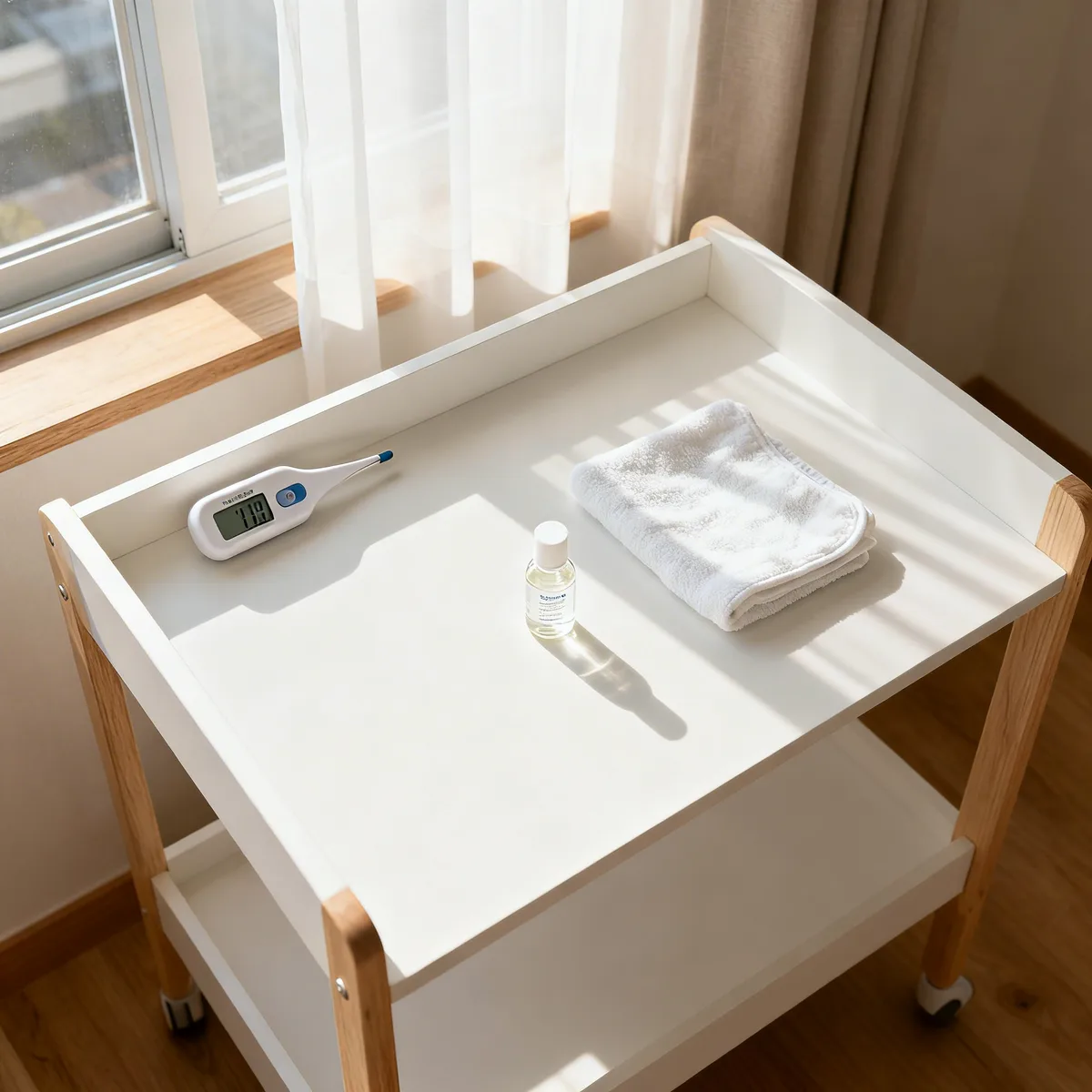
For a rectal reading, use a digital thermometer with a small amount of petroleum jelly on the tip. Insert it no more than one inch, hold it gently in place, and wait for the beep.
A reading of 100.4°F (38°C) or higher confirms a fever. Ear and forehead thermometers are convenient, but accuracy varies in young infants — rectal remains the gold standard for this age group.
Once you’ve confirmed baby fever, comfort measures can help your baby feel better while their immune system does its work. Dress them in a single light layer and keep the room at a comfortable temperature — overheating can make things worse.
Fluids matter. Breast milk or formula provides hydration and immune support. Offer feeds more frequently than usual if your baby is willing.
For fever management in babies older than two months, the AAP recommends acetaminophen (Tylenol) at the appropriate weight-based dose. Ibuprofen is only appropriate for babies six months and older. Always confirm the correct dose with your pediatrician before giving any medication.
Lukewarm sponge baths can offer brief comfort but won’t lower core temperature significantly. Skip cold water or alcohol rubs — both can cause shivering, which raises body temperature rather than lowering it.
Home care is generally appropriate when your baby is older than three months, the fever is below 102°F, and they remain alert and able to feed. If your baby is also showing unusual skin changes — such as infant yellow skin alongside fever — that warrants a prompt call to your care provider.
A baby’s age is the single most important factor in deciding how urgently to act on a fever.
Newborns under three months old have immune systems that are still developing. They can’t mount the same defensive response to infection as older babies, and serious bacterial infections — including sepsis and meningitis — can progress rapidly with very few outward signs.
The AAP recommends that any rectal temperature of 100.4°F (38°C) or higher in a baby younger than three months be evaluated by a doctor right away, even if your baby looks otherwise well.

This threshold exists because it’s genuinely difficult to distinguish a minor viral illness from something more serious in a newborn. Clinicians rely on lab work, not symptoms alone, to make that call.
From three months onward, the picture shifts. A baby fever in this age group can often be monitored at home, provided your baby is alert, feeding, and the temperature stays below 102°F. Behaviour and responsiveness become meaningful data points in a way they simply aren’t in the first weeks of life.
Around this same age, you may notice other changes — disrupted sleep patterns, increased fussiness, and new developmental activity. The 3 month sleep regression often coincides with this developmental window, which can make it harder to read your baby’s baseline.
One practical note: rectal temperature remains the most accurate method for babies under three months. Axillary (underarm) readings run lower and are not reliable enough to guide decisions at this age.
When in doubt about a newborn’s temperature, contact your care provider before waiting to see how things develop.
The AAP recommends against giving fever-reducing medication with the sole goal of bringing a number down. The focus should be on how your baby is feeling — not the thermometer reading.
If your baby has a fever but is drinking fluids, responding to you, and resting comfortably, medication may not be necessary. The immune response a fever triggers is doing useful work.
When your baby is clearly uncomfortable — crying persistently, refusing to feed, or unable to sleep — acetaminophen or ibuprofen can help. Ibuprofen is only appropriate for babies six months and older.
Dosing is based on weight, not age. The concentration of infant liquid formulas can vary between brands, so always use the measuring device that comes with the product and check the label each time.
Never give aspirin to a child. It is associated with Reye’s syndrome, a rare but serious condition affecting the brain and liver.
Alternating acetaminophen and ibuprofen is a common workaround parents try, but the AAP advises caution with this approach — the overlapping schedules are easy to miscalculate, which increases the risk of accidental overdose.
A baby fever that responds to medication and then returns between doses is not automatically a sign something is wrong. That pattern is normal. What matters is how your baby looks and behaves when the medication is active.
If you’re navigating the 4 month leap at the same time, remember that fussiness and disrupted sleep during that window can look a lot like illness. Checking temperature first helps you separate the two.
Keep a written log of doses and times. It removes the guesswork — especially during night wakings when it’s easy to lose track.
A rectal temperature of 100.4°F (38°C) or higher is considered a fever in infants at any age. However, age matters significantly — any fever in a baby under 3 months requires a call to your pediatrician, while the same temperature in a 6-month-old may warrant watchful monitoring rather than emergency care.
No. While fever often signals an infection your baby’s immune system is fighting, it can also result from vaccinations, teething, overdressing, or even a warm environment. The accompanying symptoms and your baby’s overall behavior are more telling than the fever number alone.
Seek emergency care immediately if your baby has a fever above 104°F (40°C), a stiff neck or sensitivity to light, a purple or red rash that doesn’t fade when pressed, labored breathing, extreme difficulty waking, or a bulging soft spot. Any fever in a baby under 12 weeks also warrants an immediate call to your doctor or ER visit.
Fever-reducing medicine like acetaminophen or ibuprofen (for babies over 6 months) can be given safely at proper doses, but medication isn’t always necessary. Many fevers run their course effectively without medicine, and letting the fever continue can actually help your baby’s immune system fight the infection more effectively.
A low-grade fever after vaccination is a normal sign that your baby’s immune system is responding to the vaccine and building protection. This typically appears within 24 hours and resolves on its own — it’s not a cause for concern and doesn’t mean the vaccine caused harm.